 QualBuddy
Interpretative phenomenological analysis
Interpretative phenomenological analysis,
step by step.
Interpretative phenomenological analysis (IPA) is a qualitative method for studying how people make sense of an experience that matters to them. It works one case at a time, stays close to the participant’s own words, and treats your reading of their account as part of the analysis. This guide follows the seven analytic steps of Smith, Flowers and Larkin’s second edition (2022), from the interview to the write-up, with one fictional extract carried through every stage. It is written for students and researchers doing IPA for the first time, and for anyone who learned the method from the 2009 edition and wants the current terms.
Alex, Sam and Rowan are fictional participants written for this guide, and their words and the analysis are invented. The steps follow Smith, Flowers and Larkin (2022). They are a way of working rather than a recipe, and you will move back and forth between them.
How this guide is organised
Seven steps, and what sits either side of them.
The numbered steps below are the seven steps of analysis in Smith, Flowers and Larkin (2022). The interview comes before them and the write-up after, because what you ask shapes what you can analyse, and the analysis is not finished until it is written.
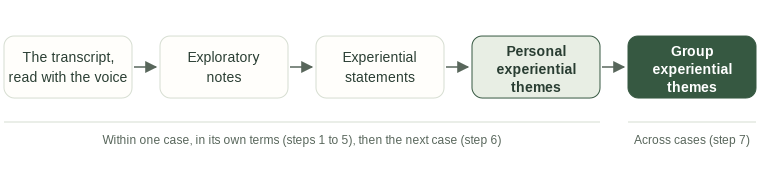
If you learned IPA from the 2009 edition, the shape is the same and some names have changed. What were called emergent themes are now experiential statements, and the superordinate themes of a single case are now personal experiential themes; the themes developed across cases are group experiential themes. The second edition made the change to keep the focus on experience and on the individual case. Older papers, and many university handouts, still use the older words.
Before you begin
The stance: curious, close, unhurried
IPA asks how a person makes sense of an experience that matters to them. It is phenomenological, because it attends to experience in its own terms. It is interpretative, because you are making sense of someone making sense of their experience, which the method calls the double hermeneutic. And it is idiographic, because it stays with one person at a time before it looks across people.
That asks something of you as well as of the method. Arrive curious rather than certain. Stay close to the moment being described. Go slowly. Hold your readings lightly, and notice what the account stirs in you.
The writers of this guide come to IPA from clinical practice, and borrow one idea from it. Mentalization-based treatment calls this the not-knowing stance: a genuine curiosity about another person’s experience, which accepts that you cannot already know it. It is not part of IPA, and an interview is not therapy, but the stance travels well. Keep your distress protocol to hand, especially when the topic is sensitive.
Curious
“I wonder what they mean” rather than “I know what they mean”.
Close
The particular moment, in their words, before any theory.
Unhurried
Slow down, go back, stay with what matters.
Before the analysis
The interview: ask what it was like
Good IPA data begins with good questions: open, experiential and few. A semi-structured interview with a short schedule of six to ten questions is the usual source. Ask for particular moments rather than opinions or explanations, then follow where the participant takes you. They are the experiential expert.
| Instead of | Try |
|---|---|
| “Why don’t you ask for help?” | “Can you tell me about the last time you needed help?” |
| “Do you find closeness difficult?” | “What happens for you when someone gets close?” |
| “Was it stressful?” | “What was that like for you?” |
Prompts that keep you close
- “Can you say more about that?”
- “When you say ‘packs a bag’, what is that like?”
- “Can we go back to just before that happened?”
- “Have I understood that right?”
- Interviewer
- What happens for you when someone gets close?
- Alex
- When someone gets close… part of me quietly packs a bag. I’m still there, still smiling. I’ve just already left.
- Interviewer
- Can we stay with that bag for a moment? What’s in it?
- Alex
- Mostly… a reason. Something I can say if I need to go.
- Interviewer
- So leaving first feels safer. Have I got that right?
- Alex
- Not safer. Just… less of a surprise.
Transcribe the whole interview, including pauses, laughter and false starts, because the linguistic notes in step 2 depend on them. Keep the recording: you will listen to it again.
Step 1
Reading and re-reading: read it again, with the voice
Read the whole transcript once without making notes. Then listen to the recording as you read: the pause, the laugh, the voice dropping, the words said quickly or slowly. Read it again. You are getting to know a person, not mining a text.
Put your first impressions in your reflexive diary rather than the margin. Writing them down helps you set them aside, so you can meet the account as it is.
When someone gets close… [pause] part of me quietly packs a bag. [laughs] I’m still there, still smiling. I’ve just already left.
Step 2
Exploratory noting: three ways of noticing
Work through the transcript closely, line by line, noting anything of interest. Smith, Flowers and Larkin describe three kinds of exploratory note: descriptive, linguistic and conceptual. Use all three before you name anything.
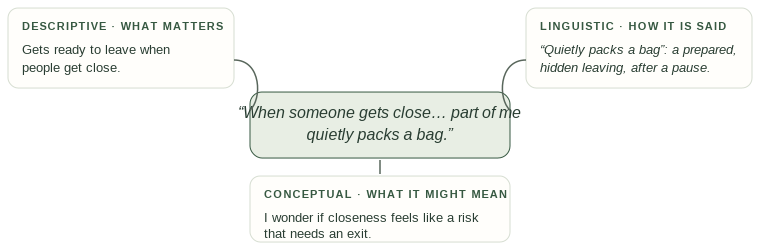
Descriptive
What matters to them here? The things, events, relationships and feelings they describe, in their own words. Stay close to the surface first.
Linguistic
How do they say it? Metaphor, repetition, pauses, laughter, tense, the shift from “I” to “you”, what is rushed or left unfinished.
Conceptual
What might it mean? Questions you ask of the text, tentatively. Your understanding begins to enter here, still anchored to their words.
Alex’s words, noticed three ways
| Extract | Descriptive | Linguistic | Conceptual |
|---|---|---|---|
| “When someone gets close… [pause] part of me quietly packs a bag.” | Gets ready to leave when people get close. | “Quietly packs a bag”: a leaving that is prepared, and hidden. The pause before it. | I wonder if closeness feels like a risk that needs an exit. |
| [laughs] “I’m still there, still smiling.” | Stays, and smiles. | A laugh straight after; the repeated “still”. | Could smiling be a way of leaving without being seen to? |
| “I’ve just already left.” | Feels gone while present. | “Just already”: as if it were ordinary. | Is being half-gone a way of staying at all? |
| “Mostly… a reason. Something I can say if I need to go.” | Keeps a reason ready to leave. | The trailing “Mostly…”: hesitation before naming it. | Could the exit be words rather than a door, a story ready to tell? |
| “Not safer. Just… less of a surprise.” | Corrects the interviewer: it is not about safety. | “Not safer”: a firm correction, then a pause. | Perhaps what is guarded against is the shock of being left. |
Notice how the conceptual notes stay tentative: they wonder and ask. They open readings to test against the rest of the interview, rather than settling them.
Step 3
Constructing experiential statements: say what it was like
Now work mainly from your notes rather than the transcript. Bring the notes on each passage together into a short statement that captures what was important in this part of the account. A good experiential statement holds both the participant’s experience and your understanding of it. It stays close to the text, and it is never a topic or a label.
| A topic | An experiential statement |
|---|---|
| Relationships | Quietly leaving, while still there |
| Anxiety | Closeness as something to prepare for |
| Coping | Smiling as a way out |
| Fear of rejection | Leaving first, so it is less of a surprise |
Check each statement
- Can you point to the words it comes from?
- Does it say something about this person’s experience, rather than about the topic in general?
- Would Alex recognise the experience in it, even if the words are yours?
- Is it short enough to hold, and still alive?
An hour of interview usually yields dozens of statements. That is expected; the next step is about finding the shape among them.
Step 4
Searching for connections across experiential statements
List every experiential statement from the case in the order it arose, then break that order. Many people print the list, cut it into strips and move them around a table; a map on a screen does the same job. You are looking for how the statements relate, and there is more than one way to look.
- Put like with like. Statements that speak to the same experience sit together, and the cluster earns a new name.
- Let one statement stand for others. Sometimes a statement is broad enough to hold several more specific ones beneath it.
- Notice opposites. Statements that pull against each other can be as revealing as those that agree: wanting closeness and preparing to leave it.
- Group by context or time. Statements about the same moment, place or relationship may belong together.
- Count, lightly. How often something returns says something about its weight, though not everything.
- Ask what the account is doing. A statement may matter for its function in the telling: the joke that softens, the correction that insists.
For Alex, four statements drawn from the extract above gather round one experience of leaving before being left. Others from the rest of the interview, about wanting company and about the cost of being the one who goes, pull against it, and that tension will matter in the write-up. Not every statement finds a home: let the ones that stay outside stay outside, and note them.
Step 5
Naming the personal experiential themes and consolidating them in a table
Name each cluster as a personal experiential theme (PET), and make a table of every theme with its experiential statements and where each one lives in the transcript, so that every claim can be traced back to the words. A PET is a statement about this person’s experience, and it should still sound like them. If it could belong to anyone, go back to the particular words that made it. Larger clusters can carry sub-themes.
A personal experiential theme for Alex
Leaving before being left
| Experiential statement | Where |
|---|---|
| Quietly leaving, while still there | Lines 12 to 13 |
| Closeness as something to prepare for | Lines 12, 31 |
| Smiling as a way out | Line 13 |
| Leaving first, so it is less of a surprise | Line 18 |
Nigbur and Chatfield (2025) offer practical advice on naming: a good theme name describes an experience rather than labelling a topic, is specific to the case, and can usually be read as a sentence or a phrase the participant might recognise. “Leaving before being left” passes; “Attachment difficulties” would not.
Step 6
Continuing the individual analysis of other cases
Then move to the next participant and begin again at step 1. Let each account surprise you, rather than looking for the themes you found before. Bracketing what you learned from Alex is part of staying idiographic, and your reflexive diary is where that bracketing happens: write down what you now expect to find, so that you can notice when you are finding it too easily.
Each case ends with its own table of PETs. Only when every case has one do you look across them.
Step 7
Working with PETs to develop group experiential themes
With each case analysed in its own right, look across the personal experiential themes to develop group experiential themes (GETs). Attend to what people share and to how each person lives it differently. Convergence and divergence both belong in the analysis, and a GET keeps the individual voices within it rather than averaging them away.
A group experiential theme
Care without return
“I’m the one everyone rings. I’ve never been sure who I’d ring.”
“If I stop holding it together, who holds the rest?”
- Shared
- Caring that is not returned.
- Lived differently
- Sam is unsure anyone would be there; Rowan cannot put it down.
A group theme that flattens these differences loses what IPA is for. Let the reader hear each voice, and say what the variation means. A GET can hold group-level sub-themes, each still traceable to the PETs and statements beneath it.
After the analysis
Writing up: their words, your reading
Present each theme as an unfolding account, with the participants’ words and your interpretation side by side. The extract is the evidence; your commentary is the analysis. A possible paragraph for Alex’s theme:
For Alex, closeness arrives with its own preparations: “when someone gets close… part of me quietly packs a bag.” The bag is packed quietly, a leaving made ready in advance and kept out of sight, while Alex stays “still smiling”. Asked what is in it, Alex names “a reason. Something I can say if I need to go.” The exit is a story rather than a door. When the interviewer suggests that leaving first feels safer, Alex corrects the reading: “Not safer. Just… less of a surprise.” What Alex guards against may be less closeness itself than the shock of being left.
Nizza, Farr and Smith (2021) describe four markers of high-quality IPA:
- a compelling, unfolding narrative;
- a vigorous experiential or existential account;
- close analytic reading of participants’ words;
- attention to convergence and divergence.
If you have been told your analysis is “a bit descriptive”, the third marker is usually where to begin: return to the words, and ask what they do as well as what they say.
Questions people ask
Common questions about IPA
- How many participants does an IPA study need?
- Fewer than you might think. IPA favours small, fairly homogeneous samples analysed in depth: three to six interviews is common for a student project, a doctorate often has between four and ten, and single-case studies are a recognised form. Depth in each case matters more than the number of cases.
- Should I use IPA or reflexive thematic analysis?
- Choose IPA when your question is about how particular people make sense of a significant experience, and you want to stay with each person before comparing them. Reflexive thematic analysis (Braun and Clarke, 2022) develops patterns of shared meaning across a whole dataset from the start and suits broader questions and larger, more varied samples. The two are often confused; their stances towards the individual case are the clearest difference.
- What happened to emergent and superordinate themes?
- They were renamed in the 2022 edition of Smith, Flowers and Larkin. Emergent themes became experiential statements, and the superordinate themes of a single case became personal experiential themes; across cases, the themes are group experiential themes. Use the current terms, and expect to meet the older ones in papers written before 2022.
- Do I need software to do IPA?
- No. Many people work with printed transcripts, pens and a large table. Software helps most with keeping notes beside the words they belong to, listening to the recording as you read, tracing every statement and theme back to its lines, and moving statements around when you look for connections.
- How do I show that my analysis is any good?
- By making it traceable and by writing it well. Keep the tables that link each theme to its statements and lines, keep your reflexive diary, let a supervisor or colleague read a case against its transcript, and judge the write-up against the four markers above. IPA does not use inter-rater reliability; two readers agreeing is not what it is trying to achieve.
Keep this beside your transcript
The checklist
Before the interview
- Questions ask about moments, not opinions
- Distress protocol ready
- Reflexive diary open
In the interview
- Ask what it was like
- Slow down; go back to the moment
- Check: have I understood that right?
1 · Reading
- Read once without notes
- Listen as you read
- First impressions in your diary
2 · Exploratory notes
- Descriptive: what matters to them
- Linguistic: how they say it
- Conceptual: what it might mean
3 · Experiential statements
- About experience, not topics
- Traceable to the words
- Holding their experience and your understanding
4 · Connections
- Like with like, and opposites
- Context, frequency, function
- Statements left outside are noted
5 · Personal experiential themes
- Still sound like the person
- Each with its statements and line numbers
- Named as an experience, not a topic
6 · The next case
- Begin again at step 1
- Expectations written down, then set aside
7 · Group experiential themes
- What is shared
- How each person lives it differently
Writing up
- Extracts and interpretation side by side
- Every theme grounded in their words
- An account that unfolds
Take it with you
Print it, keep it close
The guide · PDF
IPA, step by step.
Everything on this page, laid out on A4 pages, with the checklist on a page of its own to keep beside your transcript.
Download the guideBlank worksheet · DOCX
A space for your own case.
An editable IPA analysis worksheet with prompts for exploratory notes, experiential statements and a PET table.
Download the worksheetBoth are free, with no signup. This guide is a starting point, not a substitute for the methodological literature or your supervisor’s guidance.
Beyond this guide
One case, in depth.
Our worked example follows a different fictional account, of returning to university, through exploratory notes, experiential statements and PETs, with an interactive map of how the statements connect.
Read the IPA worked example ↗About QualBuddy
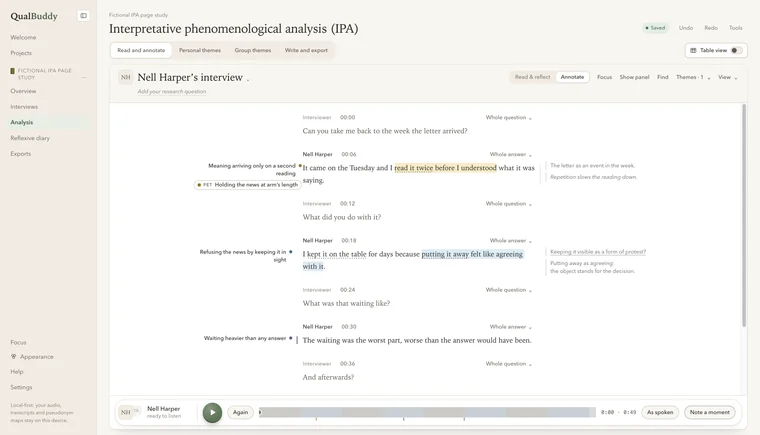
Where the notes sit beside the words.
QualBuddy is a Mac and Windows app built around these steps: the recording sits beside the transcript, exploratory notes and experiential statements live in the margins, PETs and GETs come together on a map, and every theme stays traceable to its lines. The interpretation stays yours. Transcription runs on your own computer.
How the IPA workspace holds each step ↗Try QualBuddy free for 14 days →