 QualBuddy
A guide to the method
What is interpretative
phenomenological analysis?
Interpretative phenomenological analysis (IPA) is a qualitative research method for studying how particular people make sense of an experience that matters to them. It takes each person’s account on its own terms, treats the researcher’s reading of that account as part of the analysis, and only then looks across people for what is shared and what is not. Its current statement is the second edition of Smith, Flowers and Larkin’s Interpretative Phenomenological Analysis: Theory, Method and Research (2022). This guide is for students and researchers meeting IPA for the first time, and for supervisors who want a current summary.
Alex, the one participant quoted on this page, is fictional, written for our step-by-step guide. The words and the analysis are invented, and nothing here is real research data. The method and its terms follow Smith, Flowers and Larkin (2022).
The definition
What IPA is: making sense of how people make sense of experience
IPA studies lived experience, one person at a time. Its participant has been through something significant, such as a diagnosis, a loss or a change of role, and is now making sense of it. An IPA study asks that person to describe the experience in their own words, usually in a long interview, then works through the account slowly to understand what it was like and what it has come to mean. The researcher’s understanding is not kept out of this. It is the instrument of the analysis, used with care and shown openly.
The product is an account of experience built case by case. For each participant the researcher develops personal experiential themes, each grounded in that person’s words. Only when every case has been analysed in its own right does the researcher look across them for group experiential themes, which hold what the participants share alongside the ways each lives it differently. The write-up puts extracts and interpretation side by side, so a reader can see where every claim comes from.
Smith, Flowers and Larkin’s second edition (2022) sets out the theory, the steps of analysis and a complete study, and it updated the method’s vocabulary. Smith and Nizza (2022) give a shorter account in the American Psychological Association’s Essentials series. If you learned IPA from the 2009 edition, the shape is the same and some names have changed; the terms table below sets them out.
Where it comes from
Origins, and the three theoretical commitments
Jonathan Smith set out IPA in a 1996 paper in Psychology and Health. He argued for a way of studying people’s accounts of their experience that neither reduced them to cognitions to be measured nor treated them only as talk to be taken apart: an approach that took what people said seriously as a report of experience, while recognising that an account is always made, first by the person and then by the researcher. The method grew in health psychology and is now used across psychology, nursing, education, social work and beyond.
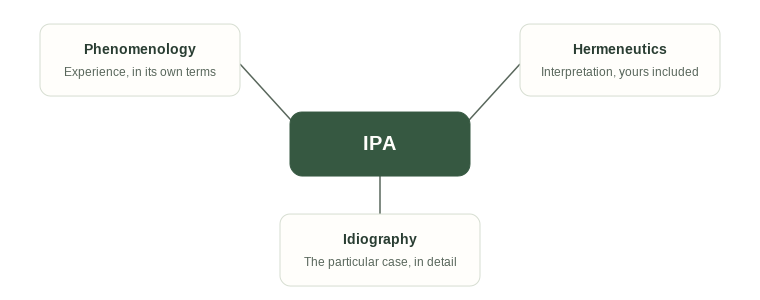
Smith, Flowers and Larkin describe IPA as resting on three bodies of thought. Phenomenology gives it its subject, hermeneutics its way of working, and idiography its scale.
Phenomenology
The philosophical study of experience: Husserl’s return to things as they are experienced, Heidegger’s person always already in a world, Merleau-Ponty on the body, Sartre on becoming. IPA takes from them its subject, experience in its own terms.
Hermeneutics
The theory of interpretation. With Heidegger, IPA holds that there is no access to experience without interpretation, so the researcher’s reading cannot be set aside and must be used well and shown. The double hermeneutic follows from this.
Idiography
A concern with the particular: this person, this experience, this context, in detail. It is why samples are small, why each case is analysed in full before any comparison, and why the general is approached through the particular.
The double hermeneutic is what makes IPA interpretative rather than descriptive. The participant is making sense of their experience; the researcher is making sense of the participant making sense of it. Your reading can go beyond what the participant said, because you see the account whole and can ask what its metaphors and silences might mean. It must also stay answerable to the words, because their sense-making is what you are trying to understand. Smith, Flowers and Larkin describe this as a hermeneutics of empathy combined with a hermeneutics of questioning, the questioning grounded in the text rather than in a theory brought from outside. Meaning also moves between part and whole, which is why the steps below are a way of working and not a recipe.
Fit
What kind of research question suits IPA
IPA suits questions about how particular people make sense of a significant experience. The question is experiential: it asks what something was like and what it has come to mean, not how often it happens or what causes it. It is open, because the answer is to be found in the accounts rather than tested against a hypothesis. And it is about something that matters: a diagnosis, a bereavement, becoming a parent, leaving a profession, a return to education after years away.
| A question IPA can answer | A question it cannot |
|---|---|
| How do adults diagnosed with type 1 diabetes in their thirties make sense of the change to their everyday lives? | Does a self-management programme improve glycaemic control in adults with type 1 diabetes? |
| What is it like for newly qualified nurses to be present at a patient’s death for the first time? | How many newly qualified nurses leave the profession within two years, and why? |
| How do mature students experience returning to university after a long gap? | Which factors predict whether mature students complete their degrees? |
The questions on the right are good questions; they need a trial, a survey or a cohort study. Those on the left share a form: a particular group, a particular experience, and “how” or “what is it like” rather than “why” or “whether”. A question that begins with why pulls the analysis towards explanation and away from experience. A good IPA question fits in one sentence; if yours needs sub-questions about causes, prevalence or effectiveness, narrow the question rather than stretch the method.
Sampling
Who to interview, and how many
IPA samples are small, fairly homogeneous and purposive. Purposive means that participants are chosen because they can speak to the experience in question, not because they represent a population. Homogeneous means that they share the experience closely enough for comparison to mean something: people who all received the same diagnosis within the same year let convergence and divergence stand out, where a varied sample would only show variety. How homogeneous is a judgement for each study, and depends on how rare the experience is and who is willing to take part. Small follows from the idiographic commitment: each case takes many hours to analyse well, and every case must be complete before any are compared.
| Project | Interviews, as a rule of thumb | Notes |
|---|---|---|
| Undergraduate or master’s project | Three to six | Enough to compare, few enough to analyse each in depth in the time available. |
| Professional or research doctorate | Often four to ten | Interviews rather than people: a smaller group interviewed more than once is a recognised design. |
| Single-case study | One | A legitimate form of IPA in its own right, when one account is rich enough and the question concerns the particular. |
These are ways of working rather than rules; the guidance in Smith, Flowers and Larkin (2022) goes by level of study and by what the project is for. The more useful question than “how many” is “how deep”. Four cases, each analysed fully and written with care, make better IPA than twelve in which each person is reduced to a few lines. A question that seems to need a large or varied sample may be a question for reflexive thematic analysis.
Data collection
How data are usually collected
Most IPA studies use semi-structured, in-depth interviews, one to one, lasting an hour or more. You bring a short schedule, usually six to ten open questions with possible prompts, and hold it lightly: it is there so that the conversation can range, not so that every question is asked in order. The participant is the expert on their own experience; your job is to help them describe it in detail, then follow where they lead.
What a good experiential question looks like
- Open. It cannot be answered with yes or no, and it does not contain its own answer: “What happens for you when someone gets close?” rather than “Do you find closeness difficult?”
- About a particular time. “Can you tell me about the day you were told?” brings a moment into the room; “What do you think about the diagnosis?” invites an opinion.
- In everyday words. No theory, no jargon, nothing to translate before answering.
- Followed, not finished. The best question is often the next one: “Can you say more about that?”
Transcription, and the recording
Transcribe the whole interview, word for word, with pauses, laughter, false starts and hesitations marked, because the linguistic notes depend on them. Number the lines, so that every note and theme can be traced to its place. Keep the recording and listen again as you read: tone, pace and emphasis are part of the account, and a transcript alone loses them.
Other forms of data
Interviews are not the only source. Diaries and other written first-person accounts suit experiences that unfold over time, some studies interview the same person twice, and some gather accounts of one experience from several people around it. Whatever the source, it needs to be a rich, first-person account of a particular experience.
The analysis
The seven steps of analysis, in brief
Smith, Flowers and Larkin (2022) describe analysis in seven steps. The first five happen within one case, the sixth repeats them for the next case, and only the seventh looks across cases. The names below are the book’s. Our step-by-step guide works through all seven steps with one fictional extract, and the worked example follows one case in depth with an interactive map.
| Step | What you do |
|---|---|
| 1 · Reading and re-reading | Read the whole transcript, then read it again while listening to the recording. Put first impressions in a reflexive diary rather than the margin, so that you can set them aside. |
| 2 · Exploratory noting | Work through the transcript line by line, noting anything of interest. The book describes three kinds of exploratory note: descriptive, for what matters to the person; linguistic, for how they say it; conceptual, for what it might mean. |
| 3 · Constructing experiential statements | Work mainly from the notes now. Bring the notes on each passage together into a short statement of what was important there, holding both the person’s experience and your understanding of it. |
| 4 · Searching for connections across experiential statements | Break the order of the list and look for how the statements relate: like with like, one standing for others, opposites that pull against each other, statements that share a context or a function in the telling. |
| 5 · Naming the personal experiential themes and consolidating them in a table | Name each cluster as an experience rather than a topic, and build a table of every personal experiential theme (PET) with its statements and their line numbers, so that each is traceable to the transcript. |
| 6 · Continuing the individual analysis of other cases | Begin again at step 1 with the next participant. Write down what you now expect to find, so that you notice when you are finding it too easily, and let the new account surprise you. |
| 7 · Working with PETs to develop group experiential themes | Look across the cases for what the participants share and for how each lives it differently. A group experiential theme (GET) keeps the individual voices within it; convergence and divergence both belong in the analysis. |
One extract, one note, one statement
Alex is a fictional participant from our step-by-step guide. Asked what happens when someone gets close, Alex said:
When someone gets close… part of me quietly packs a bag. I’m still there, still smiling. I’ve just already left.
| What it is | Example |
|---|---|
| A linguistic exploratory note, from step 2 | “Quietly packs a bag”: a leaving that is prepared in advance and kept out of sight. The pause before it. |
| An experiential statement, from step 3 | Quietly leaving, while still there. |
The note stays with how the words are said. The statement says what the experience was, in a phrase that still sounds like Alex and can be traced to its line. Neither is a topic. In the full guide this statement joins three others in a personal experiential theme, “Leaving before being left”.
Vocabulary
Terms to get right: the 2009 names and the 2022 names
The second edition renamed the products of analysis. Smith, Flowers and Larkin made the change to keep the focus on experience and on the individual case: a statement about experience is harder to mistake for a topic than a theme is, and a personal theme is plainly one person’s. The older words remain in papers published before 2022 and in many university handouts.
| In the 2009 edition and older papers | In the 2022 edition | What it names |
|---|---|---|
| Initial noting | Exploratory noting | The line-by-line notes of step 2: descriptive, linguistic and conceptual. |
| Emergent themes | Experiential statements | The short statements built from the notes on each passage of one transcript, in step 3. |
| Superordinate themes, within one case | Personal experiential themes (PETs) | The named clusters of experiential statements for a single participant, in step 5. |
| Master themes, or superordinate themes across cases | Group experiential themes (GETs) | The themes developed across the participants from their PETs, in step 7. |
Use the current terms in your own writing, including when you discuss older studies, and say once in your method section which edition you follow. What has not changed matters too: the analysis still proceeds case by case, and the themes are still built from the words.
Quality
What makes IPA good
Nizza, Farr and Smith (2021) set out four markers of high-quality IPA, illustrated through published studies they regard as exemplary.
- It constructs a compelling, unfolding narrative. The analysis tells the story of the experience, extracts and interpretation building on one another, rather than listing themes.
- It develops a vigorous experiential or existential account. The themes are about the experience and what it meant for the person’s life, body, relationships and sense of self.
- It reads participants’ words closely. The interpretation attends to particular words, metaphors and turns of phrase, and shows the work it does with them.
- It attends to convergence and divergence. Across cases, the account shows what is shared and how each person lives it differently.
Smith (2011) reviewed a large body of published IPA studies and set out what separates acceptable work from good: a clear focus; strong data; rigour, with enough extracts from enough participants to support each theme; room for each theme to develop; analysis that interprets rather than describes; attention to convergence and divergence; and careful writing. Smith, Flowers and Larkin (2022) also use Yardley’s (2000) four principles as a frame: sensitivity to context, commitment and rigour, transparency and coherence, and impact and importance.
Traceable
Every theme sits in a table with its statements and line numbers, so that any claim can be followed back to the words. The book’s independent audit is the model: a file, from interview schedule to final draft, that someone else could follow.
Reflexive
You are half of the double hermeneutic, so your part is written down, from first impressions to how your reading changed, in a reflexive diary and then in the write-up.
Written well
In IPA the writing is part of the analysis: the participant’s words and your reading, side by side, in an account that unfolds. Our guide to writing up IPA findings covers this.
Why inter-rater reliability is not the test
Inter-rater reliability asks whether two coders, working independently, give the same labels to the same segments of text. It is the right test for a method that treats coding as measurement, and IPA does not. Its analysis is an interpretation made by a particular researcher through the double hermeneutic; a second researcher would make a different one, and the method does not treat that as error. What a good IPA study offers instead is credibility: an audit trail another person can follow, a colleague who has read a case against its transcript and found the reading grounded, and a write-up in which the reader can weigh the interpretation against the extracts. If an examiner asks for a kappa, explain, with references, why IPA checks quality this way.
Choosing a method
How IPA differs from reflexive thematic analysis, descriptive phenomenology and grounded theory
IPA is often confused with its neighbours, and the confusion matters because the methods make different promises.
| Method | The question it answers | How the analysis works | Sample, and what it produces |
|---|---|---|---|
| IPA (Smith, Flowers and Larkin, 2022) | How particular people make sense of a significant experience. | Case by case, then across cases. Interpretation is central and shown, anchored to the words. | Small, homogeneous, purposive. Personal experiential themes for each person, then group experiential themes that keep the individuals visible. |
| Reflexive thematic analysis (Braun and Clarke, 2022) | What patterns of shared meaning run across a dataset, on experiential or critical questions. | Across the whole dataset from coding onwards, in six recursive phases. Themes are developed by the researcher, whose subjectivity is a resource. | Flexible, often larger and more varied. Themes, each a pattern of shared meaning around a central concept. |
| Descriptive phenomenology (Giorgi, 1997) | What the essential structure of an experience is, across those who describe it. | The researcher sets aside their own interpretations as far as they can, divides the descriptions into meaning units and draws out the general structure. | A few people who have lived the same phenomenon. A description of the structure of the experience, not themes for each person. |
| Grounded theory (Glaser and Strauss, 1967) | How a social process works, and what theory explains it. | Coding and constant comparison from the first data onwards, with theoretical sampling until the categories are saturated. | Grows as the theory develops. A theory or model, with its categories and the relations between them. |
Against reflexive thematic analysis, the clearest difference is the stance towards the individual case: IPA finishes each person before it compares anyone, while reflexive thematic analysis develops patterns across the dataset from the start. Both are interpretative and both produce themes, which is why they are confused. Choose IPA when the question is how these particular people live this particular experience, and reflexive thematic analysis for patterns across a broader group. Our guide to reflexive thematic analysis describes that method on its own terms.
Against descriptive phenomenology the difference is the place of interpretation, which IPA uses and shows rather than sets aside; against grounded theory it is the aim, an understanding of an experience rather than a theory of a process.
What supervisors see
Common problems in IPA studies, and what helps
The same problems recur in student IPA, and most are visible to a supervisor within a page. Each has a remedy that comes from the method.
| The problem | What it looks like | What helps |
|---|---|---|
| Description without interpretation | The findings paraphrase what participants said. An extract is followed by “this shows that Alex finds closeness difficult”, which repeats it in other words. | Ask what the words do as well as what they say. Write linguistic and conceptual notes, not only descriptive ones, and let each extract be followed by a reading that adds something. |
| Themes that are topics | Names such as “Relationships”, “Support” or “Coping strategies”. They sort the data into subjects and could belong to any study of anyone. | Name each theme as an experience, in a phrase the participant might recognise: “Leaving before being left” rather than “Attachment”. Nigbur and Chatfield (2025) give practical advice on naming. |
| Losing the individual in the group themes | The group themes read like a survey: one line from each of eight people, no one present for more than a sentence, divergence smoothed away. | Finish each case before comparing any. Build the group themes from the personal themes, and in each show what is shared and then how two or three people live it differently. |
| Too many participants | Fifteen interviews and two pages of findings. Each case gets an afternoon, and the analysis becomes thematic analysis with IPA’s vocabulary. | Decide the number from the time you have to analyse, not the time you have to recruit. For most student projects three to six interviews are enough. |
| Leading questions | “Did you feel abandoned when that happened?” The participant agrees, and “Feeling abandoned” appears in the findings. The researcher’s reading entered the data before the analysis began. | Open, experiential questions about particular moments. Pilot the schedule and listen back to the first interview before the second. Where a question led, treat the answer with care and say so. |
Questions people ask
Common questions about IPA
- Is IPA only used in psychology?
- No. It began in health psychology, but it is widely used in nursing, midwifery, education, social work, occupational therapy, counselling and sport, wherever the question is how particular people make sense of a significant experience.
- Do I have to read Husserl and Heidegger to do IPA?
- No, but you should understand why they matter. Smith, Flowers and Larkin (2022) explain the phenomenological and hermeneutic ideas IPA draws on in a chapter written for researchers rather than philosophers, which is enough to use the method well and to answer an examiner.
- Can IPA use written accounts or focus groups instead of interviews?
- Written first-person accounts such as diaries can work well when they are rich and particular. Focus groups are harder: IPA wants each person’s account in depth, and a group discussion produces something shaped by the group. If you must use one, analyse it with care for each voice and say so in the method.
- Can two people analyse the same IPA data?
- Yes, as collaboration rather than a reliability check. A supervisor or colleague who reads a transcript and its notes and offers readings of their own makes the analysis better. The aim is a richer interpretation, not agreement, and the final reading remains the researcher’s own.
- How is an IPA study written up?
- As an account of the group experiential themes in turn, each developed through extracts with the researcher’s interpretation beside them, showing what is shared and how individuals differ. A summary table of themes usually opens the findings, with the full tables in an appendix. Our guide to writing up IPA findings goes through this.
Beyond this guide
Next, the steps in full.
Our step-by-step guide works through the seven steps with one fictional extract and a printable checklist, the worked example follows a single case in depth, and the writing-up guide takes the analysis to the page.
IPA step by step: the seven steps worked through ↗One case in depth, with an interactive map ↗Writing up IPA findings ↗The reflexive thematic analysis guide ↗All the research guides ↗About QualBuddy
Built around these steps.
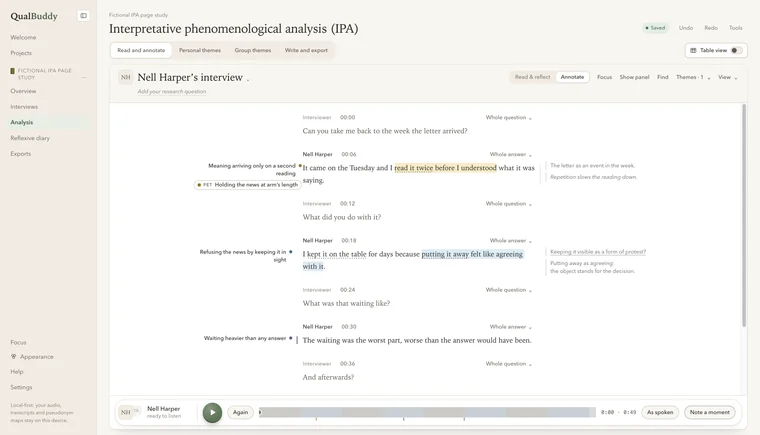
QualBuddy is a Mac and Windows app built around the seven steps. The recording sits beside the transcript, exploratory notes and experiential statements live in the margins, PETs and GETs come together on a map, and every theme stays traceable to its lines. Transcription runs on the researcher’s own computer. It is free for 14 days, without a card.
How the IPA workspace holds each step ↗Try QualBuddy free for 14 days →