 QualBuddy
ES 1 · Holding back questions to protect a fragile sense of competence
“I had a question ready, but I kept thinking everyone else would find it obvious, so I stayed quiet.”
P01 · line 2 · Initial theme: Trying to belong without exposing uncertainty
Interpretative phenomenological analysis
Keep your interpretation beside the words that prompted it, from your first exploratory note to the write-up.
Inside the app
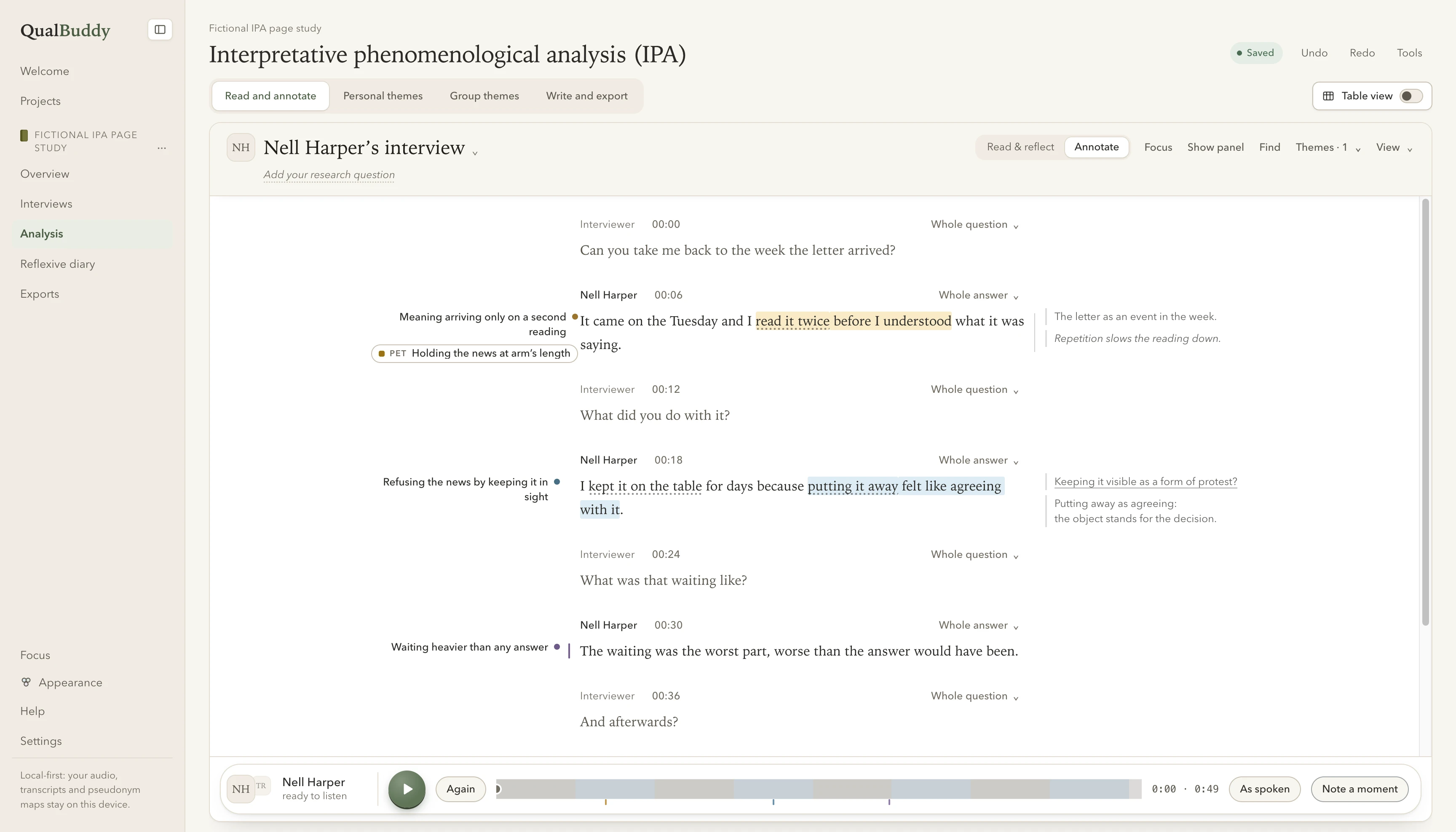
Transcript passages, exploratory notes and experiential statements in one workspace. Actual app screen with fictional material.
Close reading, with room to reflect
Select source words and develop descriptive, linguistic and conceptual notes alongside them. Link experiential statements to the passages that prompted your reading. Move between reading, annotation and a table view as your understanding develops.
Your notes and statements remain connected to their source. Return to the wider account, reconsider a phrase and revise your interpretation as you work.
A little space to think
Drag a bubble. Explore a quote.
Give an ES a theme—or leave it open.
Unassigned
This is a simplified browser example using fictional interview material. It is not a screenshot of the desktop app. PETs group experiential statements; unassigned statements remain open for interpretation. No GETs are shown for this single participant.
Drag to arrange. Select an ES to change its theme. Keyboard: Enter selects; arrow keys move. List view offers the same relationships and quotes. Changes stay in this example and Reset restores the starting arrangement.
“I had a question ready, but I kept thinking everyone else would find it obvious, so I stayed quiet.”
P01 · line 2 · Initial theme: Trying to belong without exposing uncertainty
“When nobody answered my comment, I went home wondering whether I belonged there at all.”
P01 · line 3 · Initial theme: Trying to belong without exposing uncertainty
“Reading my notes on the bus gave me something to hold on to before I walked into the room.”
P01 · line 5 · Initial theme: Finding steadiness through preparation and recognition
“The tutor remembered what I had said the week before. After that, I found it easier to speak.”
P01 · line 6 · Initial theme: Finding steadiness through preparation and recognition
“At home I knew exactly what was expected of me. At university I was still working out who I could be.”
P01 · line 7 · Initial theme: Unassigned
“That hour in the library was the first bit of the week that felt like it belonged to me.”
P01 · line 8 · Initial theme: Unassigned
Built around IPA
Stay with each participant’s account, then explore shared and contrasting experiences across cases. Arrange themes in the map and return to their supporting passages.
Give your first observations and developing interpretations a place alongside your work with the interview.
Put into words what matters in the participant’s experience, bringing your reading and interpretation together.
Bring related experiential statements together into PETs while working carefully with each individual case.
Develop group experiential themes as you consider patterns and differences across participants.
What were the first seminars like when you returned to study?
I had a question ready, but I kept thinking everyone else would find it obvious, so I stayed quiet.
When nobody answered my comment, I went home wondering whether I belonged there at all.
Was there anything that helped you feel more settled?
Reading my notes on the bus gave me something to hold on to before I walked into the room.
The tutor remembered what I had said the week before. After that, I found it easier to speak.
At home I knew exactly what was expected of me. At university I was still working out who I could be.
That hour in the library was the first bit of the week that felt like it belonged to me.
From analysis to writing
Build a findings outline and develop group memos with linked evidence. Consider how participants contribute to a theme, including convergence, divergence and subthemes, and mark quotations for the write-up.
Export DOCX analysis tables with extracts, exploratory notes and experiential statements. Findings documents can cover the whole study or one case; quote banks help carry selected evidence into Word.
See the Word sample and worksheet ↗Help shape QualBuddy
Try QualBuddy free for 14 days on Mac or Windows.
No card, no automatic charges.