 QualBuddy
Your interpretation, with room to develop
Reflexive thematic
analysis software.
Keep passages, codes, themes and your developing account connected in a dedicated local workspace.
Inside QualBuddy
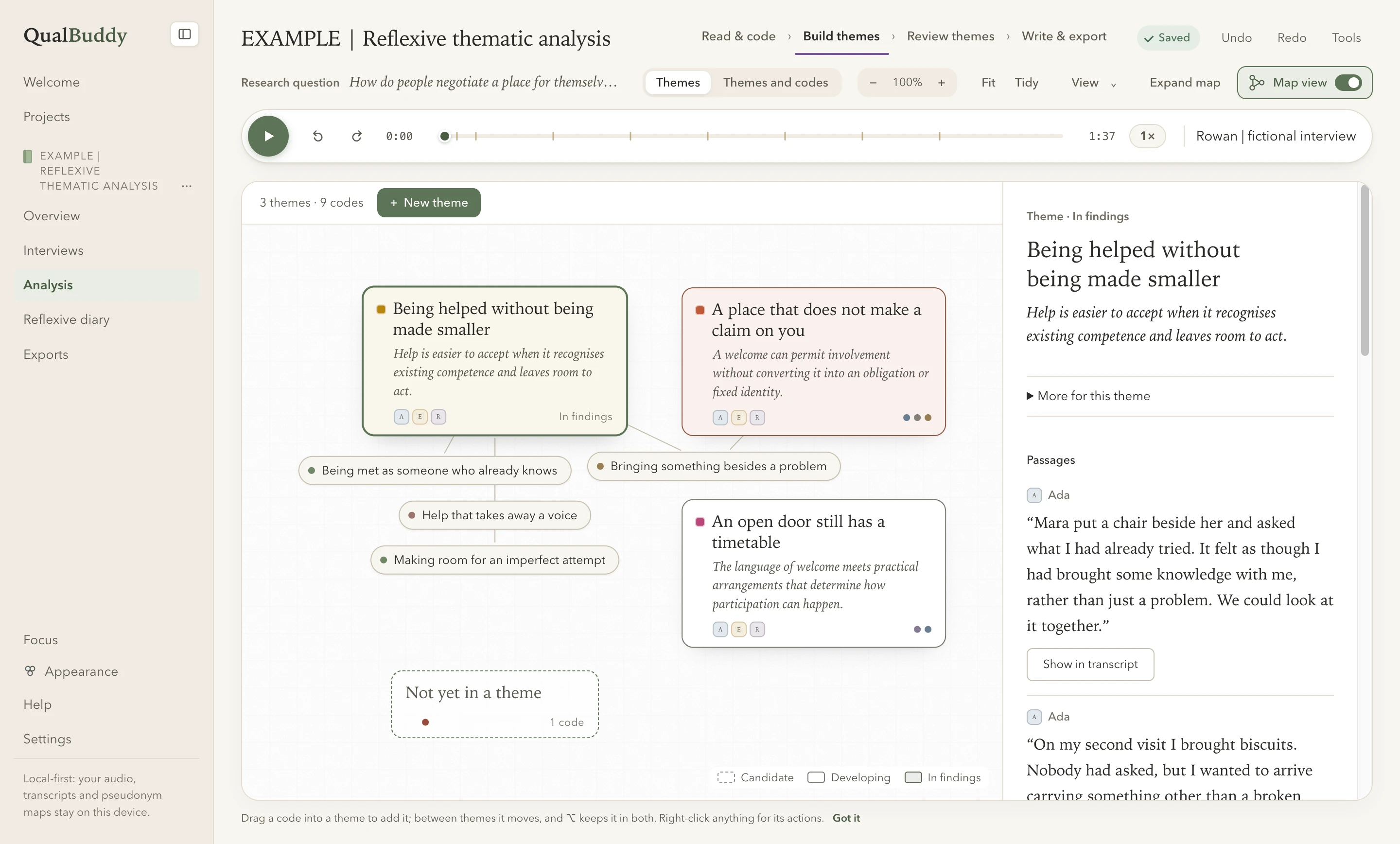
A theme, with its meaning in view.
Actual app screen from the fictional repair-workshop study, with prewritten analysis and synthetic example audio.
A workspace for thinking
Read. Reconsider.
Make meaning.
Move between reading, coding, theme development, review and writing as your interpretation changes. Study context and a reflexive diary give your perspective a place in the work.
- 01
Code source passages
Select an extract, create or apply a code, and return to its context. Add code memos as your reading develops.
- 02
Develop themes
Bring codes into candidate themes and describe the central organising concept: the shared meaning your theme develops. Keep its claim and supporting passages available as you reconsider the grouping.
- 03
Review and refine
Review a theme’s scope and boundaries, compare two themes and return to passages that complicate your reading. Record your reasoning in working memos and review notes.
- 04
Write with the evidence
Write an introduction and order your thematic account. Place chosen quotations among paragraphs, add commentary and read the account as a whole. Export findings to DOCX for Microsoft Word or Markdown.
The relationships between themes
See how the account connects.
Explore themes and codes in the map. Name relationships between themes, develop subthemes and see where codes are shared. Arrange the map to help examine your account, with source passages still within reach.
Keep the theme’s idea in view.
A theme’s central organising concept gives you something to revisit as its relationships develop. Review the evidence, refine the claim and record why you made a change. You decide what the relationships mean and which themes belong in the findings.
A fictional example from the app
From codes to a shared idea.
The example asks: how do people negotiate a place for themselves in a community repair workshop? These two passages come from a prewritten study of three invented accounts. They illustrate one analytical connection, not a complete analysis or automatically generated findings.
“Mara put a chair beside her and asked what I had already tried. It felt as though I had brought some knowledge with me, rather than just a problem. We could look at it together.”
Example code
Being met as someone who already knows
“A volunteer took the screwdriver out of my hand to demonstrate. They meant well. I stopped talking and let them finish. It was easier than explaining that I already knew that part.”
Example code
Help that takes away a voice
Theme in the prewritten example
Being helped without being made smaller
Ada’s knowledge is invited into the encounter; Ellis’s is passed over. The shared idea concerns how help can recognise or diminish a person’s competence. The theme develops an interpretation of help, beyond collecting everything said about volunteers.
A question to take back to the accounts
Where does this interpretation become more complicated? In another passage, Ada brings biscuits so she can contribute something as well as receive help. That raises a further question about how recognition is negotiated. Return to the complete accounts before deciding what the theme can reasonably claim.
Method matters
Tools support the reading.
Reflexive thematic analysis involves active interpretation and revisiting earlier decisions. Braun and Clarke describe a flexible, recursive process, rather than a rigid checklist. QualBuddy provides space for that work; selecting codes does not determine the meaning of a theme. Read their process guidance.
Codes, themes and IPA
In reflexive TA, themes develop patterns of meaning around a shared idea. A collection of answers about one topic is not necessarily a theme. Braun and Clarke’s FAQs explain the distinction.
QualBuddy’s separate IPA workspace uses exploratory notes, experiential statements, PETs and GETs. Explore the IPA workflow.
Ready to write? Follow a fictional findings paragraph from claim to evidence.
Starting with recorded interviews? Explore local transcription and transcript review.
Help shape QualBuddy
A little space
for your next study.
Try QualBuddy free for 14 days on Mac or Windows.
No card, no automatic charges.