 QualBuddy
A worked example
Reflexive thematic analysis,
from coding to a defined theme.
Reflexive thematic analysis is Braun and Clarke’s approach to developing themes, patterns of shared meaning organised around a central concept, across a whole dataset, with the researcher’s subjectivity treated as a resource rather than a problem. This page carries one short fictional interview exchange through the six phases of their 2022 guide, from the first reading to a defined theme and a written paragraph. It is written for students and researchers doing reflexive TA for the first time, and for anyone whose themes have been called topics.
Ada, Ellis, Noor and Priya are fictional participants in QualBuddy’s repair-workshop example; their words, the codes, the themes and the journal entries are invented. The phases follow Braun and Clarke (2022) and are a way of working, not a recipe.
The fictional study
Four interviews about finding a place in a repair workshop
The study asks how people negotiate a place for themselves in a community repair workshop, a monthly event where volunteers help people mend their own things. Four people gave semi-structured interviews, recorded and transcribed in full: Ada, who first came with her mother’s lamp; Ellis, who brought a toaster and did not like the help; Noor, who came with a radio and now helps at the soldering bench; and Priya, who comes most weeks and makes the tea.
The analysis is inductive and experiential, with critical realist assumptions, and uses semantic and latent codes; reflexive TA asks for such choices to be stated.
The exchange carried through the phases
- Interviewer
- Can you tell me about the first time you took something in?
- Ada
- My mother’s lamp. The switch had gone. I nearly didn’t go. I thought they’d take one look and think, here’s another one who can’t do anything.
- Interviewer
- What happened when you got there?
- Ada
- Mara put a chair beside her and asked what I had already tried. It felt as though I had brought some knowledge with me, rather than just a problem. We could look at it together.
- Interviewer
- You said “together”.
- Ada
- She held the lamp and I did the screws. I went home and told my daughter I’d fixed it, and that was true, mostly.
- Interviewer
- Do you still go?
- Ada
- Most months. I take a tin of biscuits now. [laughs] I know what that is. If I turn up with biscuits I’m not just turning up with my hands out. The hall is freezing in January, so they go down well.
- Interviewer
- What would it be like to go without them?
- Ada
- Odd. Like going to someone’s house for dinner and bringing nothing. You can. But you feel it.
One passage from Ellis is coded beside Ada’s exchange; a second appears in phase 4.
A volunteer took the screwdriver out of my hand to demonstrate. They meant well. I stopped talking and let them finish. It was easier than explaining that I already knew that part.
How this guide is organised
Six phases, named as the book names them
Braun and Clarke (2022) describe six phases: familiarising yourself with the dataset; coding; generating initial themes; developing and reviewing themes; refining, defining and naming themes; and writing up. The names have changed since 2006; the current ones are used here. Each phase builds on the last, but the process is recursive: reviewing sends you back to coding, and writing is the last test of a theme. They are tools, not rules.
Phase 1
Familiarising yourself with the dataset: read it again, with the question in mind
Familiarisation means reading and re-reading the whole dataset, listening to the recordings, and noting first analytic observations about each transcript and the dataset as a whole, before any coding. Read Ada’s exchange once without a pen, then again with the question in mind. Notes might include these.
- Ada’s story starts before she arrives: she expects to be read as “another one who can’t do anything”, and the welcome she describes is a welcome against that expectation.
- Twice she pairs what she brings with what she lacks: “some knowledge” against “just a problem”, biscuits against “hands out”.
- The laugh and “I know what that is” show Ada reading her own behaviour. The analysis should not simply adopt her reading.
- All four participants talk about what they give as well as what they get, and Ada and Ellis give the same kind of moment, a volunteer stepping in, opposite meanings.
Keep a reflexive journal from the first reading; assumptions have to be written down to be worked with.
I warmed to Mara’s chair at once. I like the professional who asks before acting, and that fondness could make me read every act of asking as kind and every act of taking over as unkind. Ellis excuses the volunteer. I should take the excuse seriously.
Phase 2
Coding: labels for what matters, across the whole dataset
Coding works systematically through every transcript, labelling each segment that might matter for the question. A code is the analytic idea; the label is the phrase that carries it. Codes can be semantic, close to what was said, or latent, naming a meaning beneath the surface. Braun and Clarke describe two or more rounds of coding, after which codes and extracts are collated. The codes are yours: there is no codebook to apply, and labels change as your understanding does.
Codes across Ada’s and Ellis’s extracts
| Extract | Code | Semantic or latent | Note |
|---|---|---|---|
| Ada: “here’s another one who can’t do anything.” | Expecting to be seen as incapable | Latent | Ada arrives already positioned; the first theme turns on the judgement she fears. |
| Ada: “Mara put a chair beside her and asked what I had already tried.” | Being met as someone who already knows | Semantic | “Some knowledge, rather than just a problem” is coded here too. |
| Ada: “She held the lamp and I did the screws.” | Doing the work with one’s own hands | Semantic | “True, mostly” takes a second code, Claiming the repair as one’s own. |
| Ada: “If I turn up with biscuits I’m not just turning up with my hands out.” | Giving something back | Semantic | Later split: by the second round this label was carrying two meanings (phase 3). |
| Ada: “The hall is freezing in January.” | Cold hall in winter | Semantic | Coded because it was there; later discarded as not about the question (phase 4). |
| Ada: “Like going to someone’s house for dinner and bringing nothing.” | Help as hospitality, with its obligations | Latent | The workshop becomes a host’s house, where receiving carries a debt. |
| Ellis: “A volunteer took the screwdriver out of my hand to demonstrate.” | Help that takes away a voice | Latent | When the tool goes, Ellis stops talking. |
| Ellis: “They meant well.” | Excusing the helper | Semantic | Ellis protects the volunteer from his own criticism. |
| Ellis: “easier than explaining that I already knew that part.” | Going quiet rather than claiming competence | Latent | Being made smaller is paid for in silence, framed as the easier choice. |
Coding is inclusive at first, and it is not counting: a code used once can matter more than one used everywhere, and whether a code earns its place is settled later, against the question.
I nearly coded the biscuits as “gratitude”. Ada did not say gratitude. She said “hands out”. The code should keep her economy, not my politeness.
Phase 3
Generating initial themes: clusters of codes with an idea that holds them
With the coding collated, the work shifts from segments to patterns. Lay the codes out and look for those that share a meaning rather than a subject. A candidate theme is a cluster of codes with an idea that could hold them together: a proposal to test, not a finding. Collate the extracts for each candidate, ready for phase 4.
The second round of coding had already split “Giving something back”. For Ada it meant the biscuits, settling what she felt she owed; for Noor, showing newcomers the soldering bench; for Priya, having the tea to make: “It gives me a job. I’m not just sitting there being helped.” A debt paid and a role taken are different ideas, so the code became two: “Giving something so help is not one-sided” and “Becoming someone who helps”.
| Candidate theme | Codes gathered | First assessment |
|---|---|---|
| Being helped without being made smaller | Expecting to be seen as incapable · Being met as someone who already knows · Help that takes away a voice · Going quiet rather than claiming competence | Help that recognises competence, or passes over it, across all four accounts. The strongest candidate. |
| Evening up the exchange | Giving something so help is not one-sided · Help as hospitality, with its obligations · A job of one’s own · Becoming someone who helps | Being helped creates a debt, settled in kind. To be tested against the whole dataset. |
| The volunteers | Excusing the helper · Mara’s chair · “They’re all retired engineers” (Noor) | A bucket: everything said about one group of people, with no idea holding the codes together. Set aside; its codes are re-homed in phase 4. |
| Doing it yourself | Doing the work with one’s own hands · Claiming the repair as one’s own | Coherent, but possibly a facet of the first candidate. Carried to phase 4 as a question. |
The third candidate is the one to learn from. Braun and Clarke call it a topic summary: what participants said about a subject, with nothing to unify the observations. Its codes were good codes; they belonged elsewhere.
Phase 4
Developing and reviewing themes: against the extracts, then against the whole dataset
Reviewing happens at two levels: against the coded extracts, asking whether everything under a candidate forms a coherent pattern around one idea; and against the whole dataset, asking whether the candidates together tell a convincing story that answers the question. Themes are split, combined or discarded here, and the analysis often goes back to coding. Here it led to five decisions.
- The first candidate held. Every extract under it concerned help that recognised competence or passed over it.
- “The volunteers” was set aside and its codes re-homed: “Excusing the helper” joined the first theme, because the excuse is part of how being made smaller is borne, and “Mara’s chair” duplicated “Being met as someone who already knows”.
- “Doing it yourself” was merged into the first theme as a candidate subtheme, “Whose hands are on the repair”: the concrete form of the theme, not a separate idea.
- The analysis went back to coding. Ellis’s second visit had been left uncoded: “I took something I knew I couldn’t do, so there would be no argument about who was in charge.” Coded as “Choosing a problem that leaves no room for dispute”, it tested the theme’s edge and belonged to it.
- “Cold hall in winter” was discarded. It describes the venue, not the negotiation of a place.
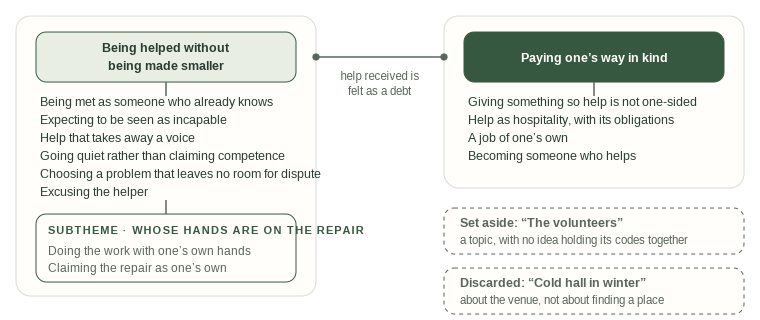
The relation came from the whole-dataset reading: Ada’s biscuits sit in the second theme but exist because of the first. Recognition is not only something a volunteer gives; participants work to negotiate it.
I wanted “The volunteers” to be a theme because the volunteers are where the drama is. Read back, it is a list of everything said about them, with no idea holding it together. Taking it apart moved its best codes where they belong.
Phase 5
Refining, defining and naming themes: one idea, its edges, its name
A theme is refined by writing about it: its scope and focus, the story it tells, and an informative name, in Braun and Clarke’s terms. A short written definition is the surest test, because a topic cannot be defined this way and a theme can. The first theme is set out as a card; a real study would write a few paragraphs for every theme.
Theme definition
Being helped without being made smaller
| Part of the definition | For this theme |
|---|---|
| Central organising concept | Help in the workshop can recognise a person’s competence or reduce their room to act, and whether someone feels they have a place depends on which. |
| Scope and boundaries | The moment help is given or taken: the question that invites what someone knows, the hand that takes the tool, the silence or strategy that follows. It includes the expectations people bring to the door, and stops where they describe what they give in return. |
| Candidate subtheme | Whose hands are on the repair: doing the work, and being able to say “I fixed it”. |
| What it is not | Not a summary of everything said about volunteers, nor a verdict on them: Mara and the volunteer with the screwdriver appear for what their help did, not for who they are. Not a tally of good and bad help. |
The second theme, in brief
- Name
- Paying one’s way in kind.
- Central concept
- Being helped is felt as a debt, and participants keep their place by settling it with what they can give: biscuits, the tea, a swept floor, and in time help of their own.
- Boundary
- What participants do to deserve a place, not gratitude in the abstract.
Names carry meaning, not topic. “Volunteers” names a topic; “Being helped without being made smaller” says what the pattern is.
Phase 6
Writing up: a claim, the words it rests on, and what they mean
Writing up is still analysis: a theme that cannot be written convincingly is not finished. The writing makes a claim, the extracts show the words it rests on, and the commentary interprets rather than repeats them; the analysis is then related to the literature. A paragraph for the first theme might begin like this.
In this workshop, help positioned the person receiving it before any repair was made. Ada arrived braced to be read as “another one who can’t do anything”, and met instead a chair and a question: Mara “asked what I had already tried”. The question did more than gather information. It treated what Ada knew as part of the repair, so that she could come with “some knowledge” rather than “just a problem”. Ellis’s account reverses the sequence. When a volunteer took the screwdriver from his hand to demonstrate, he “stopped talking and let them finish”, because it was “easier than explaining that I already knew that part”. The tool and the voice went together, and the cost of keeping the peace was paid in silence. Together, the accounts suggest that being made smaller is not a matter of unkindness; Ellis is careful that the volunteer “meant well”. It is a matter of where a person’s competence is placed, inside the repair or outside it, waiting. Ellis’s later choice to bring “something I knew I couldn’t do, so there would be no argument about who was in charge” shows how much that placing matters. He kept his place by giving up the claim in advance.
The paragraph does not report that Ada liked the help and Ellis did not. It uses both accounts to say how help positions the person receiving it, while keeping the difference between the two people alive. Our guide to writing reflexive TA findings takes the same theme through another paragraph.
Boundaries of the method
What this example does not show, and why
Three things reviewers sometimes ask for are missing on purpose. Braun and Clarke are clear that reflexive TA does not use them.
Data saturation
The coding did not stop because “nothing new was found”. Saturation assumes that meaning sits in the data waiting to be found, and that a point arrives when the data has given it all up. In reflexive TA, themes are the researcher’s interpretive work, so the analysis could always go further; stopping is a judgement about whether it is rich enough for its purpose, and should be described as that.
Inter-rater reliability
No second coder checked agreement. For Braun and Clarke, agreement shows that two people were coding in the same way, not that the coding is accurate. Working with another researcher is welcome, to deepen the engagement with the data rather than to check it.
A codebook
No fixed codebook was applied. Coding in reflexive TA is open and evolving: here a code was split, one discarded and one added during reviewing. The list of codes made at the end of coding is a tool for clustering, not a frame to apply. Approaches that build a codebook early to check consistency are codebook or coding-reliability forms of thematic analysis.
Keep this beside your transcripts
The checklist, phase by phase
1 · Familiarisation
- Read the whole dataset, more than once
- Listen as well as read
- First observations, per transcript and across them
2 · Coding
- Everything relevant to the question
- Semantic and latent, as the data asks
- Two rounds at least; let the codes change
3 · Initial themes
- Cluster by shared meaning, not topic
- Name the idea that holds each cluster
- Collate the extracts for each candidate
4 · Developing and reviewing
- Check against the coded extracts
- Check against the whole dataset
- Split, merge, set aside; recode if needed
5 · Refining, defining and naming
- One sentence for the central organising concept
- Scope, boundaries, subthemes
- A name that carries the meaning
6 · Writing up
- Open with the claim
- Extracts as evidence, interpretation around them
- Relate the analysis to the literature
Throughout
- Reflexive journal open
- Notice what you want to find
- Record why you changed something
Questions people ask
Common questions about this example
- How many codes should I end up with?
- There is no right number. What matters is that the whole dataset has been coded for anything relevant to the question, in more than one round, and that the codes are specific enough to build themes from.
- Why is “The volunteers” not a theme?
- Because it is a topic. It gathers everything said about one group of people. A theme is a pattern of shared meaning organised around a central concept. Braun and Clarke (2021) list the confusion of topic summaries with themes among the common problems in published thematic analysis.
- Can someone else code my transcripts with me?
- Yes, to deepen the analysis rather than to check it. Reflexive TA does not use inter-rater reliability, because agreement shows that coders were coding alike, not that the coding is right.
- Do the six phases have to be done in order?
- They build on each other, but the process is recursive. Here, reviewing sent the analysis back to coding, and writing was the last test of the theme. Expect to move back and forth, and say so in your method section.
Beyond this example
The method, and the writing.
Our guide to what reflexive thematic analysis is sets out the approach and its assumptions, and the writing guide takes the theme defined here into a findings section.
What reflexive thematic analysis is ↗Writing reflexive TA findings ↗All the research guides ↗About QualBuddy
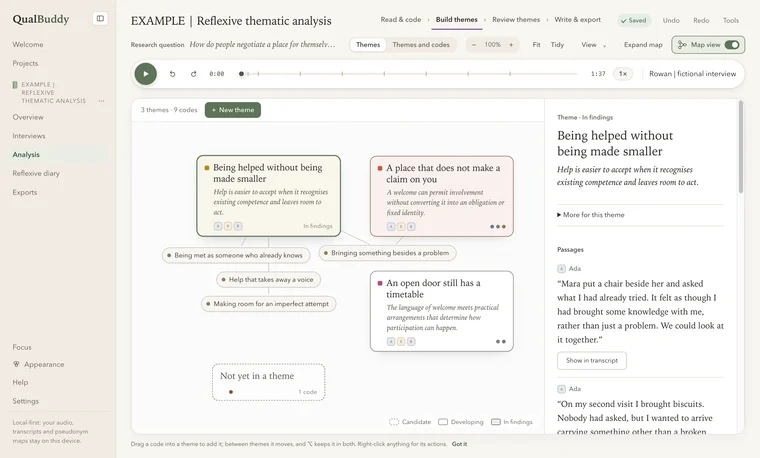
Where the codes stay beside the words.
QualBuddy’s reflexive thematic analysis workspace keeps codes beside the passages they come from, holds themes with their central organising concept on a map with subthemes and relations between themes, lets the findings be written with the quotations in place and exported to Word or Markdown, and keeps a reflexive diary beside the analysis. Interviews are transcribed on your own computer. It is free for 14 days, without a card.
How the reflexive TA workspace holds each phase ↗Try QualBuddy free for 14 days →