 QualBuddy
Reflexive thematic analysis
Reflexive thematic analysis,
explained.
Reflexive thematic analysis is a method for developing, analysing and interpreting patterns of meaning across a qualitative dataset. The researcher’s subjectivity is a resource for the analysis rather than a threat to it, and themes are developed by the researcher rather than found waiting in the data. Its current statement is Braun and Clarke’s Thematic Analysis: A Practical Guide (2022). This guide is written for students, researchers and supervisors who want a current, accurate summary.
The repair-workshop study in the examples is fictional. Ada and Ellis, their words and the analysis are invented for QualBuddy’s guides, and the extract and journal entry marked fictional were written for this page. The phases and terms follow Braun and Clarke (2022).
The method
What reflexive thematic analysis is
Thematic analysis develops patterns of meaning, called themes, across a dataset to answer a research question. Reflexive thematic analysis is Braun and Clarke’s way of doing it, and three commitments set it apart. Meaning is not waiting in the data to be found; it is made in the encounter between a researcher, a dataset and a question. The researcher’s assumptions, training and position are therefore a resource, to be examined and used rather than hidden, which is what the word reflexive signals. And themes are outputs, built from codes late in the process rather than decided before coding begins.
The method is theoretically flexible. It can work within a critical realist, contextualist or constructionist framework, with questions about experience or about how meaning is made, and with many kinds of textual data. Braun and Clarke still ask researchers to say what assumptions the analysis rests on, even when it is inductive.
Braun and Clarke ask that the approach be called reflexive TA or reflexive thematic analysis, not a three-letter abbreviation, because an acronym hides the reflexivity that defines it. This guide follows that request, and their language for themes: themes are developed, generated or constructed by the researcher. They are not found, and they do not emerge.
Where it comes from
Where reflexive thematic analysis comes from: 2006 to 2022
Braun and Clarke’s 2006 paper, “Using thematic analysis in psychology”, argued that thematic analysis deserved to be named and reported as a method in its own right. It set out six phases, distinguished inductive from theoretical (now deductive) approaches and semantic from latent coding, and gave a fifteen-point checklist for good thematic analysis. In “Reflecting on reflexive thematic analysis” (2019) they examined assumptions the paper had left unspoken, revised some of its phrasing and adopted the name reflexive TA, to put the researcher’s subjectivity at the centre and to mark their approach off from the coding reliability and codebook forms that had grown up beside it. Three papers in 2021 sharpened the position: “One size fits all?” on quality, “To saturate or not to saturate?” on sample size, and “Can I use TA? Should I use TA? Should I not use TA?” on the method’s neighbours. The 2022 book (SAGE, released late in 2021) is the full current statement.
The thematic analysis family
Coding reliability, codebook and reflexive approaches to thematic analysis
Thematic analysis is a family, not a single method. Braun and Clarke group it into three clusters that differ in what they assume about meaning, coding and the researcher. Coding reliability approaches treat coding as something that can be accurate, and measure it. Codebook approaches use a structured codebook without measuring agreement; they grew up in applied fields where teams share large datasets and funders want answers to set questions. Reflexive TA sits at the other end.
| What each assumes | Coding reliability TA | Codebook TA | Reflexive TA |
|---|---|---|---|
| Themes | Topics or domains, often set before coding and then evidenced | Usually topic summaries, set partly in advance and refined as the data are charted | Patterns of shared meaning around a central organising concept, developed from the codes |
| Coding | A fixed codebook, applied by independent coders | A structured codebook that guides coding and charts the analysis | Open and evolving over two or more rounds; no codebook |
| Researchers | Several coders, so that agreement can be measured | Often a team, each coding a share | Usually one; a collaborator brings another reading to discuss, not to agree with |
| Quality | Agreement statistics such as Cohen’s kappa | Systematic application of the frame and an audit trail | Reflexivity, theoretical coherence, depth, a convincing and well-evidenced account |
Framework analysis and template analysis are often taught as if they were forms of reflexive TA. They are not: framework analysis has its own stages (familiarisation, building a framework, indexing, charting, mapping and interpretation) and its matrix of cases by codes, and Braun and Clarke place both among the codebook approaches, with matrix analysis. If your study needs a codebook, choose a codebook approach and name it. The fault is calling the result reflexive thematic analysis.
What a theme is
A theme is a pattern of shared meaning, not a topic
In reflexive TA a theme is a pattern of shared meaning across the dataset, organised around a central organising concept: one idea that holds the pattern together and that the theme’s facets illustrate. Can you say in a sentence what the theme claims? If the only answer is “it is about help”, there is no theme yet.
The thing most often mistaken for a theme is a topic summary, which Braun and Clarke also call a domain summary and supervisors sometimes call a bucket. It gathers everything participants said about one topic, often one interview question. The participants share a subject but not a meaning, and nothing organises what they said except the question asked. In codebook and coding reliability approaches, where themes are inputs, that can be legitimate. In reflexive TA it is a weaker form: it reports what was asked rather than what was learned, it can be produced by sorting without interpretation, and it collapses into description.
| A topic summary | A theme |
|---|---|
| Experiences of being helped | Being helped without being made smaller |
| Bringing things to the workshop | Giving something back, so that help is not one-sided |
The left column names a subject; the right column says something. “Being helped without being made smaller”, the theme in the fictional study, rests on one central organising concept: help can recognise a person’s competence or reduce their room to act, and participants work to be helped in the first way. Ada, asked what she had already tried, feels she brought some knowledge rather than just a problem. Ellis, whose screwdriver is taken from his hand so that a volunteer can demonstrate, stops talking. Both passages are about help; the theme is about what help does to a person’s standing. A subtheme shares the theme’s central organising concept and draws out one facet; use them sparingly.
The six phases
The six phases of reflexive thematic analysis, as Braun and Clarke name them
Braun and Clarke describe six phases and are careful about the word. The phases are tools for a systematic analysis, not steps in a recipe, and the analysis is recursive: each builds on the last, but you move back and forth between them, and writing often sends you back to the data. The names below are the 2022 wording.
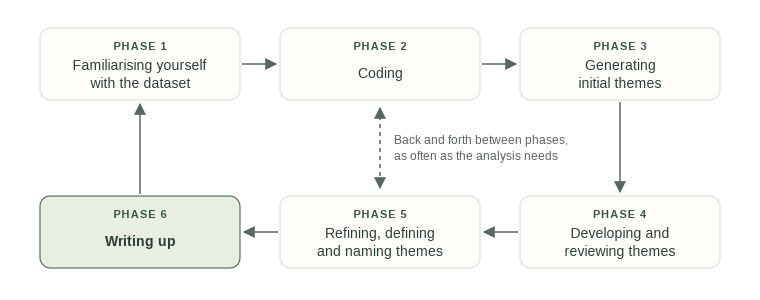
The 2006 paper named the phases differently, and many handouts still use the older names. Use one set, preferably the current one.
| Phase | 2006 wording | 2022 wording |
|---|---|---|
| 1 | Familiarising yourself with your data | Familiarising yourself with the dataset |
| 2 | Generating initial codes | Coding |
| 3 | Searching for themes | Generating initial themes |
| 4 | Reviewing themes | Developing and reviewing themes |
| 5 | Defining and naming themes | Refining, defining and naming themes |
| 6 | Producing the report | Writing up |
Three choices that shape every phase
Inductive and deductive
Inductive coding lets the data direct the codes and themes; deductive coding brings existing concepts, such as a theory of recognition, to the data. Most analyses lean one way and borrow from the other; say where you stand.
Semantic and latent
A semantic code stays with what was said: Ada brings biscuits. A latent code names an idea beneath the surface: giving something back, so that help is not one-sided. Most analyses use both.
Experiential and critical
An experiential orientation treats what participants say as telling you about their experience. A critical orientation asks what language is doing: what “just a problem” makes of a person. The fictional study is experiential.
Phase 1: familiarising yourself with the dataset
Read every transcript, listen to the recordings where you have them, and read again. Make notes on each data item and on the dataset as a whole: observations, questions, surprises and your own reactions. These are not codes. In the fictional study the researcher notices that all three participants describe a moment when a tool changed hands, and an irritation on Ellis’s behalf, which goes in the journal to be examined rather than acted on.
Phase 2: coding
Work systematically through the entire dataset, giving each segment of interest a code label: a short phrase that captures something relevant to the question. Expect two or more rounds, and let labels change, merge and split. At the end, collate every extract under its code. There is no codebook: the list of codes is a record of the analysis so far, not a frame fixed before it began.
“I started bringing a tin of biscuits. It sounds daft. But it meant I was putting something on the table as well, not just turning up with something broken and my hands out.”
The passage takes a semantic code, “Brings biscuits to the workshop”, and later a latent one, “Making the exchange two-way”. Ada’s being asked what she had tried is coded “Being met as someone who already knows”; Ellis’s screwdriver, “Help that takes away a voice”.
Phase 3: generating initial themes
Look across the codes and collated extracts for broader patterns. Cluster codes that share an idea, name each cluster provisionally, and gather its data so that you can read the candidate theme whole. Candidate themes are allowed to fail. In the fictional study, the three codes above and a code about waiting to be asked gather round a possible shared meaning: how help positions the person who receives it. A cluster about tools and equipment is set aside as a topic.
Phase 4: developing and reviewing themes
Check each candidate theme against the coded extracts, then against the whole dataset. Does each have a central organising concept, and tell a convincing story that answers the question? Ada’s biscuits do the work in the fictional study. At first they look like a separate theme about contributing. Read against the rest of her interview, they share the central idea: Ada is arranging to be helped in a way that does not make her smaller, so recognition is something a participant negotiates as well as something a volunteer gives. The researcher keeps the biscuits inside the theme as a facet, and notes in the journal that the first version had made participants passive.
Phase 5: refining, defining and naming themes
Write a short definition of each theme: its central organising concept, scope and boundaries, its facets and how it relates to the others. If a theme cannot be defined in a paragraph, it is not yet one theme. Then name it with a phrase that carries the claim.
A theme definition from the fictional study
Being helped without being made smaller
| Element | For this theme |
|---|---|
| Central organising concept | Help can recognise a person’s competence or reduce their room to act; participants work to be helped in the first way. |
| Boundaries | The repairs and the equipment are context. Whether the help worked is not the point; how it positioned the person is. |
| Facets | Being met as someone who already knows; help that takes away a voice; giving something back. |
Phase 6: writing up
Writing is part of the analysis. Weave the analytic narrative and the extracts together, so that each extract supports a claim and each claim is tested against the data as you write. Situate the analysis in the literature, and report the method as you did it. Our guide to writing reflexive thematic analysis findings follows one paragraph from claim to evidence, the worked example from coding to a defined theme shows the phases on the same material, and Byrne (2022) shows a full analysis in one paper.
Reflexivity in practice
Reflexivity in practice: the journal, and how subjectivity enters coding
Reflexivity is the practice of noticing and examining how you shape the research: your assumptions, your position and your reactions to the people you interviewed. In reflexive TA it runs through the analysis rather than sitting in a paragraph of disclosure at the end, and the journal is where it is done.
What to record in a reflexive journal
- Your expectations, written before you read the data, so that you notice when you find them too easily.
- Your position in relation to the topic and the participants, and what it makes you quick or slow to see.
- Decisions, dated: a code label changed and why, a candidate theme merged, split or dropped.
- Readings that attract you, and what you resisted.
Subjectivity enters coding at the first label. A researcher who has volunteered in a workshop may read Ellis falling silent as politeness; one who has been on the receiving end of a demonstration may code it as being silenced. Each is a reading, and the journal is where a reading is examined, argued for or given up.
Coding Ellis again. I notice I keep wanting to defend the volunteer: they meant well, he says so himself. Writing that down so I can look at it. Then back to his words. He stopped talking. The code stays.
Collaboration works the same way: a second reader brings a different subjectivity, to deepen and challenge the readings rather than to converge on one. Dated entries later let you say how the analysis was done.
Quality
Quality in reflexive thematic analysis: what counts, and what does not
The 2006 paper’s fifteen-point checklist, covering transcription, coding, analysis, the whole process and the written report, remains a sound self-check: were themes checked back against the data, does the analysis interpret rather than paraphrase, and is the method described the method used?
The sharper lens is “One size fits all?” (2021), in Qualitative Research in Psychology. Quality, it argues, cannot be judged by one standard, and many problems in published work come from treating thematic analysis as a single method. Braun and Clarke describe ten common problems in work that cites their guidance, among them treating thematic analysis as one thing, mixing incompatible approaches without acknowledgement, themes as inputs rather than outputs, topic summaries presented as themes, grounded theory concepts such as saturation imported without explanation, and analyses with too many themes, too many levels and extracts that do not support the claims. The paper closes with twenty questions for reviewers and editors.
Two measures reviewers often ask for do not belong to reflexive TA. Inter-rater reliability assumes that an accurate coding exists; in reflexive TA coding is interpretative, so agreement shows only that two people have learned to code alike. Data saturation assumes that themes are in the data waiting to be exhausted. Braun and Clarke argue in “To saturate or not to saturate?” that meaning is generated through interpretation rather than excavated, so the data never run out of themes, and how much data to collect is a situated judgement.
What to report instead
- Which type of thematic analysis you used, and why it suits the question.
- Its theoretical assumptions, and where it sits on the inductive to deductive, semantic to latent and experiential to critical continua.
- What you did in each phase, by whom, how many rounds of coding, and how themes were developed and reviewed.
- Your position in relation to the topic and the participants.
- What any collaborator did: a second reading, not a measure of agreement.
- A rationale for the size of the dataset that does not rest on saturation.
Reflexive TA and its neighbours
How reflexive thematic analysis differs from IPA, codebook TA and qualitative content analysis
Reflexive TA is most often confused with three neighbours. Interpretative phenomenological analysis (IPA) is a methodology rather than a method, and works one case at a time before looking across cases. Codebook TA treats themes as inputs and coding as the application of a frame. Qualitative content analysis builds a coding frame of categories and often reports how frequently each occurs. Braun and Clarke’s 2021 comparison paper in Counselling and Psychotherapy Research works through these differences, and our guide to what IPA is and how it works sets out the IPA side.
| Difference | Reflexive TA | IPA | Codebook TA | Qualitative content analysis |
|---|---|---|---|---|
| Unit of analysis | The dataset; patterns across cases from the start | The case, analysed in full before cases are compared | Cases and codes together, often in a matrix | Units of material assigned to categories |
| Where themes come from | Developed by the researcher from codes, late in the analysis | Built within each case, then group experiential themes across cases | Set partly in advance in the template or framework, then refined | A coding frame built from theory, the material or both |
| The researcher | Subjectivity is a resource, examined through reflexivity | Interprets the participant’s own sense-making | Consistency across coders | Consistency; a second coder often checks the frame |
| Typical output | A few themes, each an argument, written with extracts | Group experiential themes that keep the individual voices | Charted summaries by case and theme | Categories described, sometimes counted |
Braun and Clarke note that a phenomenological reflexive TA and an IPA can produce similar results. Choose IPA for how particular people make sense of a significant experience, with a small homogeneous group; choose reflexive TA for questions not only about experience, for data that are not first-person accounts, and for larger or more varied datasets.
Common faults
Common faults in work that claims to use reflexive thematic analysis
These are the faults reviewers see most often.
| The fault | Why it matters | Instead |
|---|---|---|
| Themes that are topics: “Experiences of volunteers” | A topic names a subject, not a meaning, so nothing organises the theme and it collapses into description. | Ask what the pattern claims. “Being helped without being made smaller” says something; “Help” does not. |
| Writing that themes “emerged” from the data | It casts the researcher as a bystander and the data as a container with themes inside. In reflexive TA themes are the researcher’s analytic work. | Write that you developed, generated or constructed the themes, and say how. |
| A codebook, independent coders and an agreement statistic, in a study that cites Braun and Clarke | Agreement measures assume that an accurate coding exists. Reflexive TA does not; this is one of the incompatible mixtures the 2021 quality paper describes. | Drop the measure, or name the approach as codebook or coding reliability TA. |
| Counting codes as evidence: “mentioned by eight of twelve participants” | Frequency is not meaning. A code can appear once and carry the analysis, or often because the interviewer kept asking. | Judge a theme by what it says and how well the extracts support it. |
| Mixing the 2006 and 2022 phase names, or calling it a six-step method | The phases were renamed in 2022 and are tools, not steps; two sets of names suggest second-hand learning. | Use the 2022 names, cite the book, and describe the phases as recursive. |
Questions people ask
Common questions about reflexive thematic analysis
- How many interviews do I need?
- There is no fixed number. Braun and Clarke argue in “To saturate or not to saturate?” (2021) that data saturation, stopping when no new codes or themes appear, belongs to coding reliability approaches and does not fit reflexive TA, where meaning is generated through interpretation rather than used up. Decide provisionally from the question, the depth you expect from each interview and your resources, review the decision as you analyse, and report the reasoning.
- Can I use a codebook, or ask a second person to code?
- Reflexive TA avoids codebooks and does not measure inter-rater reliability, because coding is interpretative and there is no accurate coding to agree on. Working with another person is welcome: discussing the same passages with someone who reads them differently deepens the analysis. Do not turn that conversation into a statistic.
- Is reflexive TA inductive or deductive, semantic or latent?
- Any of these, and most analyses are a mixture that leans one way. Inductive and deductive describe where the codes come from; semantic and latent describe how far beneath the surface a code goes. What matters is a coherent analysis whose orientation you state.
- How many themes should I report?
- Fewer than you might expect. Braun and Clarke’s questions for reviewers list too many themes, too many levels and overlap between themes among the signs of weak analysis. A theme needs room for its facets and extracts, so a journal article usually holds a handful and a thesis a few more.
- Do I need software for reflexive TA?
- No. Software helps most with keeping each code beside its passage, collating what is coded under a code or gathered into a theme, redrawing the thematic map, keeping the journal beside the analysis, and writing with the quotations in place.
Beyond this guide
The phases on one study, then the writing.
The same fictional material, carried through the phases and into a findings paragraph.
Follow the worked example from coding to a defined theme ↗Read the guide to writing reflexive thematic analysis findings ↗Browse all the research guides ↗About QualBuddy
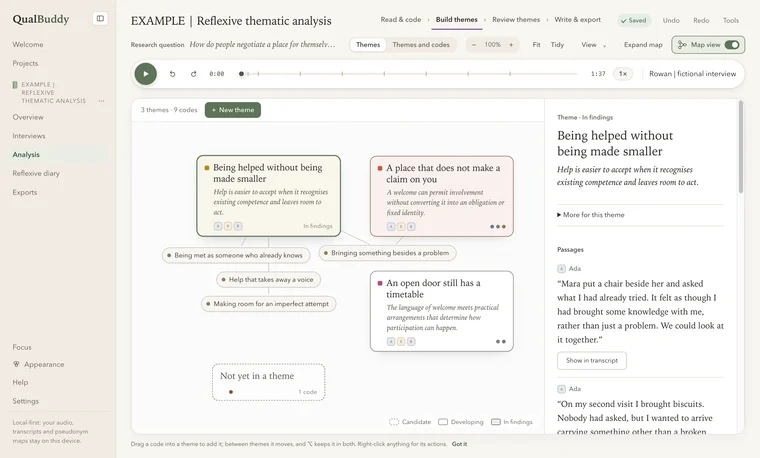
Codes beside their passages, themes with their meaning.
QualBuddy’s reflexive thematic analysis workspace keeps codes beside the passages they come from, holds themes with their central organising concept on a map with subthemes and relations between themes, lets the findings be written with the quotations in place and exported to Word or Markdown, and keeps a reflexive diary beside the analysis. Interviews are transcribed on the researcher’s own computer. It is free for 14 days, without a card.
How the reflexive TA workspace holds each phase ↗Try QualBuddy free for 14 days →