 QualBuddy
The framework method, with a worked matrix
Framework analysis,
explained.
Framework analysis, also called the framework method, is a matrix-based method for managing and analysing qualitative data case by case and theme by theme. It was developed by Jane Ritchie and Liz Spencer at the National Centre for Social Research for applied policy research, and set out for health research by Gale and colleagues in 2013. This guide is written for students, applied health and social researchers and evaluators who have been asked to use it and want to do it properly.
The repair-workshop evaluation in the examples is fictional. Ada, Ellis, Noor and Priya, their words, the framework and the matrix are invented for QualBuddy’s guides, and the extracts that do not appear on our other guides were written for this page. The stages follow Gale and colleagues (2013) and Ritchie and Spencer (1994).
The method
What framework analysis is
Framework analysis organises a qualitative dataset into a matrix. Each row is a case, usually one interviewee. Each column is a theme or one of its categories. Each cell holds a summary of what that case said about that category, with a reference back to the transcript. Gale and colleagues call the matrix the method’s defining feature. It lets the researcher reduce the data systematically and read them two ways: down a column for the range of what was said about one category, and across a row for one person’s account whole, so that a view is never cut off from its context.
The method has two names. Ritchie and Spencer called their approach Framework, and the literature that followed speaks of framework analysis; Gale and colleagues write of the framework method. They are one method, and neither name is a brand.
It is a way of managing an analysis, not a theory of knowledge. Gale and colleagues place it within the broad family often termed thematic analysis or qualitative content analysis, say it is not aligned with any epistemology, and show it used inductively, deductively or in combination. It is not, they warn, an easy version of qualitative research for quantitative colleagues: the matrix organises the data, and interpreting it takes qualitative skill.
Where it comes from
Where framework analysis comes from: Ritchie and Spencer to Gale and colleagues
Ritchie and Spencer developed the approach in the late 1980s at the National Centre for Social Research, for large qualitative studies commissioned to inform policy. Their 1994 chapter in Bryman and Burgess’s Analyzing Qualitative Data set out five stages: familiarisation; identifying a thematic framework; indexing; charting; and mapping and interpretation. Such research has set objectives, a timetable and an audience who need to see how the conclusions follow from the data. The fuller account from the same tradition is Qualitative Research Practice, now in a second edition edited by Ritchie, Lewis, McNaughton Nicholls and Ormston (2014).
The most cited account is Gale, Heath, Cameron, Rashid and Redwood’s 2013 paper in BMC Medical Research Methodology. It describes seven stages rather than five, works through a published study, and argues that non-specialists in a health research team, including clinicians and lay members, can take part under an experienced qualitative lead. Parkinson, Eatough, Holmes, Stapley and Midgley (2016) add a reflective worked example from psychology, a study of young people’s experiences of depression, written with the research team in mind; they call the method pragmatic, flexible and rigorous.
One more placement matters. Braun and Clarke describe thematic analysis as a family with three clusters, coding reliability, codebook and reflexive, and in “Can I use TA?” (2021) and Thematic Analysis: A Practical Guide (2022) they put framework analysis among the codebook approaches, with template analysis and matrix analysis. Codebook approaches set some themes in advance and apply an agreed frame across the dataset, and they are judged by how systematically and transparently the frame was applied and how well the analysis is evidenced: not by the standards of reflexive thematic analysis, where themes are developed late from open coding and the researcher’s subjectivity is the instrument, nor by the agreement statistics of coding reliability approaches. A framework analysis should be named as one and judged as one.
Choosing the method
When framework analysis suits a study, and when it does not
Gale and colleagues say plainly that the method is not for every dataset or question. It needs data that cover similar topics across cases, so that they can be categorised and compared; it cannot accommodate highly heterogeneous material. It rewards set objectives, teams, and datasets large enough to need an overview.
| Choose framework analysis when | Look elsewhere when |
|---|---|
| The study has set objectives, from a funder, a service or a policy question, and some themes are known in advance. | The question is open, the themes must come from the data, and the researcher’s reading is the centre of the analysis. Reflexive thematic analysis fits. |
| A team will share the analysis, including people without qualitative training. | One researcher wants to interpret a few cases in depth, each on its own terms. Interpretative phenomenological analysis fits. |
| The dataset is large enough that an overview by case and theme is needed to see it whole. | The cases do not cover the same ground, so there is little to put in the columns. |
| The audience needs an audit trail from each finding back to the words it rests on. | The data are recorded consultations, which Gale and colleagues send to conversation analysis, documents, which they send to discourse analysis, or life histories, which they send to narrative analysis. |
The fictional evaluation used in this guide
The repair workshop in our guides is a community event where volunteers help people mend their own things, and our reflexive thematic analysis guides ask how people negotiate a place for themselves there. This guide asks the same four people a different kind of question. The workshop’s funder wants an evaluation with four set questions: who comes, what brings them back, what gets in the way, and what the volunteers could do differently. The questions are fixed, the report is due, and the funder will want to see who said what. That is why a matrix-based method with some a priori themes suits this study better than reflexive thematic analysis.
Ada first came with her mother’s lamp and now brings biscuits so that the help is not one-sided; Ellis brought a toaster, and fell silent when a volunteer took the screwdriver from his hand; Noor came with a radio and now helps at the soldering bench; Priya comes most weeks and makes the tea. An evaluator with qualitative experience leads the analysis, a research assistant codes alongside her, and a lay member of the project’s steering group reads the matrix and joins the interpretation meetings. The approach is combined: four a priori themes from the funder’s questions, with the categories under each developed from the data. A real evaluation would interview more people; four are enough to show the matrix. If the question were how each person lives the experience of being helped, our guide to what IPA is and how it works describes the method for that; for patterns of meaning across a dataset with the researcher’s reading at the centre, see our guide to reflexive thematic analysis.
The stages
The seven stages of the framework method, as Gale and colleagues name them
Gale and colleagues describe seven stages: transcription; familiarisation with the interview; coding; developing a working analytical framework; applying the analytical framework; charting data into the framework matrix; and interpreting the data. Ritchie and Spencer’s five cover the same ground in fewer steps; the alignment below is ours. Both accounts expect the analysis to loop: the working framework is revised until the last transcript has been indexed, and interpretation begins in the notes long before the matrix is full.
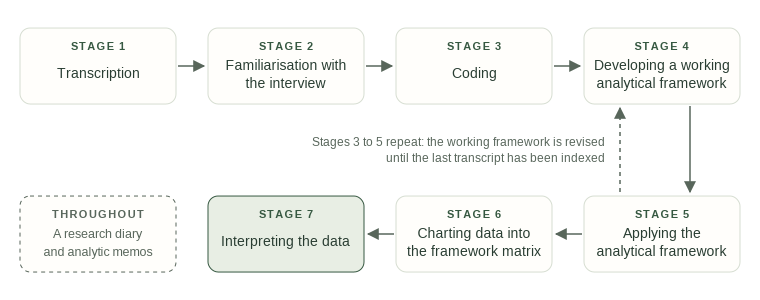
| Ritchie and Spencer (1994) | Gale and colleagues (2013) |
|---|---|
| Before analysis | 1 Transcription |
| Familiarisation | 2 Familiarisation with the interview |
| Identifying a thematic framework | 3 Coding, and 4 Developing a working analytical framework |
| Indexing | 5 Applying the analytical framework |
| Charting | 6 Charting data into the framework matrix |
| Mapping and interpretation | 7 Interpreting the data |
Use one set of names and say whose it is.
Stage 1: transcription
A good recording and, ideally, a verbatim transcript. The content is what matters, so Gale and colleagues do not require the notation of pauses and overlaps that other methods use; they do ask for wide margins and line spacing, so that codes can sit beside the words, and they encourage new researchers to transcribe themselves. The evaluation’s four interviews are transcribed in full, with a note where a laugh changes the sense of a line, and nothing finer.
Stage 2: familiarisation with the interview
Each analyst gets to know the whole interview, from the recording as well as the transcript and the interviewer’s notes. In a team the analysts are often not the interviewers, which makes this stage more important, not less. One margin is for analytic notes. The evaluator did not interview Ellis; listening to his recording she hears a long pause after the screwdriver that the transcript shows as a full stop, and writes it in the margin and in her diary.
Stage 3: coding
The analyst reads line by line and gives each passage that matters a code: a label for what has been read as important. In more inductive studies this is open coding, anything that might be relevant, from as many perspectives as possible; in more deductive studies the codes may be set in advance, though Gale and colleagues advise some open coding of a few transcripts even then. Codes can name substantive things, values, emotions, and impressions of the interview itself. Where feasible, at least two researchers code the first few transcripts independently. The evaluator and the assistant each code Ada’s and Ellis’s: both label the lamp, the toaster, the chair and the screwdriver, and only the assistant codes the biscuits, which the evaluator had read as a pleasantry.
Stage 4: developing a working analytical framework
After the first few transcripts the coders meet, compare labels and agree the set of codes to apply to the rest. Codes are grouped into categories, a tree diagram helps, and each is defined: this is the working analytical framework. Gale and colleagues expect several iterations, recommend an “other” code under each category so that data that do not fit are not ignored, and say the framework is never final until the last transcript has been coded. In the evaluation the funder’s four questions become four themes and the categories come from the coding. One category, “Something to give or do”, was not in the questions; it came from Ada’s biscuits and Priya’s tea.
The working analytical framework, version 2 · fictional
Themes from the funder’s questions, categories from the data
| Theme | Categories |
|---|---|
| 1 Routes in | 1.1 What they brought · 1.2 How they heard of the workshop · 1.3 What they expected · 1.9 Other |
| 2 What brings people back | 2.1 Getting the thing mended · 2.2 How the help was given · 2.3 Something to give or do · 2.4 Coming back, and why · 2.9 Other |
| 3 What gets in the way | 3.1 The hall and the hours · 3.2 Being taken over · 3.3 Not knowing what to bring · 3.9 Other |
| 4 What volunteers could do differently | 4.1 Asking before acting · 4.2 Handing the tool back · 4.3 Suggestions participants made · 4.9 Other |
Stage 5: applying the analytical framework
The working framework is applied to the remaining transcripts by indexing: each passage is marked with its code, usually a number or abbreviation against the lines. Software helps, and Gale and colleagues say what it does and does not do: it stores and retrieves, it does not analyse. Noor’s and Priya’s transcripts are indexed with the version 2 codes. Priya’s “It gives me a job” is indexed 2.3; Noor’s handing the soldering iron to a newcomer is indexed 2.3 and 4.2, because a passage can belong to more than one category.
Stage 6: charting data into the framework matrix
Charting summarises the indexed data by category for each case and enters the summaries in the matrix. The skill is balance: reduce the data and keep the meaning and feel of the participant’s words. Each cell carries references to the passages it summarises; Gale and colleagues suggest a capital Q with the transcript, page and line where software does not do it automatically. Teams compare their styles of summarising early and agree abbreviations. Once a team is practised, they estimate about half a day per hour-long transcript to reach the end of charting.
Stage 7: interpreting the data
Interpretation runs through the study in a notebook of impressions and in analytic memos, written whenever an idea is worth stopping for and discussed with the team. Reading the matrix, the analysts identify characteristics of and differences between the data, generate typologies, interrogate concepts and map connections between categories; if the data are rich enough, the findings go beyond description to explanation. This stage takes longer than anyone plans for.
A worked matrix
Part of the framework matrix for the repair-workshop evaluation
The matrix below shows theme 2, “What brings people back”, for the four participants. Each cell is a summary with the participant’s words in quotation marks and a reference to the lines it rests on; the line numbers are the fictional transcripts’ own. Every extract is fictional: those from Ada and Ellis also appear in our reflexive thematic analysis worked example, and the rest were written for this page.
| Case | 2.1 Getting the thing mended | 2.2 How the help was given | 2.3 Something to give or do | 2.4 Coming back, and why |
|---|---|---|---|---|
| Ada | Came with her mother’s lamp; “the switch had gone”. Mended it with Mara: “she held the lamp and I did the screws”. Told her daughter she had fixed it, “and that was true, mostly”.Q · Ada · lines 12–31 | Mara “put a chair beside her and asked what I had already tried”. Felt she had brought “some knowledge” rather than “just a problem”; “we could look at it together”.Q · Ada · lines 18–24 | Brings a tin of biscuits: “I’m not just turning up with my hands out”. Going without would be “like going to someone’s house for dinner and bringing nothing”.Q · Ada · lines 40–52 | Comes “most months”. Gives no single reason; the welcome and the biscuits are described together.Ada · lines 38–46 |
| Ellis | A toaster. The volunteer finished the repair after taking over: “it works, so I can’t complain”.Q · Ellis · lines 8–19 | A volunteer “took the screwdriver out of my hand to demonstrate”; “they meant well”. He “stopped talking and let them finish”, which was “easier than explaining that I already knew that part”.Q · Ellis · lines 14–22 | Nothing charted. Describes no role, and brings nothing except things to mend.Empty cell · checked against the whole transcript | Came back once, with “something I knew I couldn’t do, so there would be no argument about who was in charge”. Unsure whether he will go again: “I might”.Q · Ellis · lines 44–53 |
| Noor | A radio, mended on her first visit: “it still goes”. Brings nothing to mend now.Q · Noor · lines 6–15 | Shown the soldering iron, then “left to have a go”. Of the volunteers: “they’re all retired engineers”.Q · Noor · lines 16–28 | Helps at the soldering bench and shows newcomers: “I hand it over and stand back”.Q · Noor · lines 60–71 | Comes every time now, “on the other side of the bench”.Q · Noor · lines 72–78 |
| Priya | Rarely brings anything now: “I ran out of broken things a long time ago”.Q · Priya · lines 9–13 | Little charted. Helped with a kettle in her first weeks; the volunteers “know I’ll ask if I need them”.Q · Priya · lines 14–21 | Makes the tea: “It gives me a job. I’m not just sitting there being helped.”Q · Priya · lines 30–36 | Comes “most weeks”. The people and the tea come before any repair: “I’d miss them”.Q · Priya · lines 37–45 |
How to write a cell
Summarise, do not interpret
A cell says what this person said about this category, in less space. “Nothing charted” is a summary too. What it means, that the help left Ellis no role, belongs to stage 7 and a memo.
Keep the words
Gale and colleagues ask that charting describe the data in each participant’s own frames and expressions first. Short quotations let “hands out” and “a job” survive the reduction.
Reference every cell
Each summary points back to its lines. That makes the matrix an audit trail rather than a set of notes, and lets a colleague who has not read the transcript check a cell against it.
Interpretation
Interpreting the data: reading down, reading across, and keeping the link
The matrix is read two ways. Down a column is the range of a category: everything the cases said about how the help was given, from Mara’s chair to the screwdriver, and where each person sits in that range. Across a row is a case in context: Ellis’s empty cell under 2.3 sits beside his account of being taken over and his one return visit, and the three cells explain one another. Gale and colleagues add that the matrix helps a whole team see patterns, and draws attention to contradictory data, deviant cases and empty cells.
Typologies come from reading across the cases once the columns are known. In the evaluation, three ways of coming back take shape: people who still come to mend, people who come to give or to do, and people who have crossed to the volunteers’ side of the bench. Ellis fits none of them, and that is the finding about him. An association appears between two columns: those who were asked or left to have a go, Ada and Noor, found something to give or do, and the one who was taken over has nothing in that column. Associations in a matrix are not causes, and four cases prove nothing; they are the start of an explanatory account, to be tested against the rest of the data.
Memo, after charting theme 2. Column 2.3 is empty for Ellis and full for everyone who was asked first. I want to say the asking causes the giving. Four cases. What I can say is that in these accounts the two go together, and that the funder’s fourth question has an answer in Ada’s chair: ask what they have tried, then hand the tool back. Check the remaining transcripts for someone who was asked and still did not stay.
The references keep the link to the data. Every sentence in the report that says what participants said can be followed to a cell and from the cell to the lines, and the quotations in the report are the ones the cells point to. That is the audit trail Gale and colleagues describe.
Working together
Working in a team: who codes, how the framework is agreed, and what consistency means
Framework analysis was written for teams, and Gale and colleagues’ paper is above all an argument about how a team should work. An experienced qualitative researcher leads: contributing to the design and timeline, mentoring junior researchers, training clinical, lay and non-qualitative members, running analysis meetings that encourage critical and reflexive engagement, and leading the write-up. Others need not have read every transcript; the charted summaries let them engage with the data.
- Coding. At least two researchers, or one from each discipline, code the first few transcripts independently. Patients, public contributors or clinicians can code too; they stop one perspective dominating.
- Agreeing the framework. The coders meet, compare labels and agree the working framework. Disagreements are discussed, not averaged; a label one person missed, like “brings biscuits”, may become a category.
- Revising it. The framework changes as transcripts are indexed, each version kept and dated, with an “other” code under each category for what the frame did not anticipate.
- Charting alike. Early on, team members compare how they summarise and agree abbreviations, so that the matrix reads as one document.
The aim throughout is consistency: the same frame applied in the same way. Gale and colleagues do not describe inter-rater reliability statistics as part of the method; consistency comes from agreeing the framework and comparing the charting. Some teams add an agreement statistic. If yours does, say why, and recognise that it answers a different question: whether two people applied the frame alike, not whether the frame or the reading was good.
Quality
Quality and reporting: the audit trail, three risks, and what to say about reflexivity
A framework analysis is judged by whether the frame was applied systematically and transparently and whether the findings can be followed back to the data. The matrix gives most of the audit trail: raw data to indexed passages to charted summaries to themes, with the quotations marked along the way. The method section supplies the rest: the working framework as first agreed, how and why it changed, and who coded, charted and interpreted, so that a reader can see a priori themes and inductive categories for what they were.
| The risk | Why it matters | Instead |
|---|---|---|
| Staying descriptive: the report reads the matrix back, column by column | Reading the summaries out again is a longer summary, not an analysis. Gale and colleagues expect interpretation to go beyond description where the data allow. | Write the patterns across cells, the typologies and the associations, and say what explains them. Keep the summaries as evidence. |
| Forcing the data into the a priori themes | If the funder’s questions are the only columns, whatever does not answer them disappears. The biscuits and the tea were not in the questions, and they carried the clearest answer to the fourth. | Open code a few transcripts first, keep an “other” code under each category, revise the framework and report the revisions. |
| Counting from the matrix: “three of four participants said” | Gale and colleagues call such statements meaningless. The sample is purposive, chosen to capture diversity rather than to represent a population, and the spreadsheet look tempts people towards numbers. | Describe the range of a category and where cases sit in it. Say who said what, without a tally. |
What to report
- Which account you followed, Ritchie and Spencer or Gale and colleagues, and the stage names you used.
- Which themes were set in advance, from what, and which came from the data.
- The working analytical framework, with its revisions and when they were made.
- Who coded, indexed, charted and interpreted, and how the team agreed the framework and the style of charting.
- How the matrix was read: the typologies, associations and explanations, each traceable to cells and lines, and the team’s positions in relation to the service and the participants.
Reflexivity has a place even though the method does not centre the researcher’s subjectivity as reflexive thematic analysis does. Gale and colleagues say that reflexivity, rigour and quality are requisite in the framework method as in any other, and ask every team member to keep a diary. In the evaluation, the evaluator read the biscuits as a pleasantry and the assistant did not; the diary records why, and the method section can say so.
The method’s neighbours
Framework analysis compared with reflexive thematic analysis and IPA
The three methods are often shortlisted together and answer different kinds of question: framework analysis manages an analysis across cases and themes for a set purpose; reflexive thematic analysis develops patterns of meaning across a dataset through the researcher’s interpretation; interpretative phenomenological analysis examines how particular people make sense of a significant experience, one case at a time. Our guides to what reflexive thematic analysis is and what IPA is and how it works describe the other two on their own terms.
| Difference | Framework analysis | Reflexive thematic analysis | IPA |
|---|---|---|---|
| Unit of analysis | Cases and themes together in a matrix; read down for a theme, across for a case | The dataset; patterns across cases from the start | The case, analysed in full before cases are compared |
| Where themes come from | Partly set in advance from the study’s objectives, then refined from the data into a working framework | Developed by the researcher from codes, late in the analysis | Experiential statements within each case, personal experiential themes, then group experiential themes across cases |
| Codebook or framework | Yes: an agreed analytical framework, revised and reported | None; coding is open and evolving | None; the analysis works from exploratory notes on each transcript |
| The researcher and the team | Usually a team led by an experienced qualitative researcher; consistency through an agreed frame | Usually one researcher, whose subjectivity is a resource examined through reflexivity | Usually one researcher, interpreting the participant’s own sense-making |
| Typical output | Charted summaries by case and theme, then descriptive and explanatory accounts, typologies and recommendations | A few themes, each an argument, written with extracts | Group experiential themes that keep the individual voices |
| Quality judged by | Systematic, transparent application of the framework and the trail from finding to matrix to transcript | Reflexivity, theoretical coherence, depth, a convincing and well-evidenced account | Depth of interpretation, closeness to the particular case, claims grounded in the participant’s words |
The repair-workshop study appears in all three of our guide families because the same interviews can serve different questions. Asked how people negotiate a place for themselves, the reflexive thematic analysis guides develop “Being helped without being made smaller”; asked what the funder wants to know, the evaluation charts the four questions and reaches its recommendation through the matrix. Neither analysis is the other done badly.
Questions people ask
Common questions about framework analysis
- Is framework analysis the same as thematic analysis?
- It is one way of doing thematic analysis, and not the same as reflexive thematic analysis. Gale and colleagues place the framework method within the family often termed thematic analysis or qualitative content analysis; Braun and Clarke place it among the codebook approaches, because it works from an agreed framework with some themes set in advance. Name the method you used: “thematic analysis using the framework method (Gale et al., 2013)” is accurate, and “reflexive thematic analysis” for a matrix-based study with a priori themes is not.
- Do I need a priori themes to use it?
- No. Gale and colleagues are explicit that the method has no allegiance to deductive or inductive analysis. In a deductive study the codes may be set from theory or the research questions; in an inductive one they come from open coding, and the framework is built from them. Most applied studies combine the two, as the fictional evaluation does.
- Can I use framework analysis on my own, for a dissertation?
- Yes. The stages do not require a team, and Parkinson and colleagues (2016) wrote their worked example partly for psychology researchers meeting the method for the first time. A supervisor or a peer can code a transcript alongside you and discuss the framework, and the matrix lets them check a cell against the lines without reading everything. Keep the versions of your framework and your diary; they are your method section.
- Should I report inter-rater reliability?
- Gale and colleagues do not describe agreement statistics as part of the framework method; consistency comes from agreeing the framework after independent coding of the first transcripts and from comparing how the team charts. Some teams add a statistic. If yours does, give the reason and say what it measures: whether two people applied the frame alike, not whether the frame was right or the interpretation holds.
Beyond this guide
The neighbours, on their own terms.
The same fictional workshop, asked different questions by different methods.
Read what reflexive thematic analysis is ↗Read what IPA is and how it works ↗Browse all the research guides ↗About QualBuddy
A framework, a matrix, and every summary linked to its lines.
QualBuddy has a framework analysis workspace where the framework’s themes and categories are set up and revised, passages are indexed against them beside the transcript, the matrix is charted case by case with each summary linked back to its passage, and the matrix and findings export to Word. Interviews are transcribed on the researcher’s own computer. It is free for 14 days, without a card.
The methods QualBuddy supports ↗Try QualBuddy free for 14 days →